The past five years have been a wild ride intellectually and professionally. When I started this postdoc I was a year out of completing a PhD in paleontology. Specifically, I'd been looking at the relationship between bone morphology and mammal ecology in the fossil record of the North American Paleocene-Eocene (roughly the first 20 million years after the extinction of the dinosaurs) to see if it could tell us anything about the role of locomotor specialization in the success of certain groups of mammals. I came to this lab to learn the techniques necessary to do biomechanical work necessary for testing the functional aspects of the correlations between morphology and ecology I based my paleontological work on. I thought, if I thought anything (I wasn't seeing particularly far into the future at that time, for a number of reasons) that I would spend a couple of years learning the techniques in a different system, then go back to my comparative functional morphology work with a little bit of biomechanics thrown in.
Fast forward five years later, and I'm leaving this lab with a completely different research focus. I'm off to start my own lab studying swallowing in the context of neurological disorders. I'm a Co-I on an NIH funded R01 I helped write. I'm increasingly interested in incorporating more explicit neuroscience into my work. I'm still interested in comparative question, but completely different ones based on the ontogeny of musculoskeletal systems and behaviors in mammal feeding. I haven't worked on anything paleontological in 4 years. I haven't touched a fossil since I finished my PhD.
This transition, or, more accurately, this complete change of track, is something I've spent a lot of time thinking about and coming to terms with. I had wanted to be a paleontologist since I was nine. How was it that after having come close to that goal, I was willing to move away from it all of a sudden? Did I really want to give up evolutionary biology and comparative zoology? Was I selling out?
Initially, my worries about this problem were acute, until I began to realise they were based on a false story I had been telling myself about myself. Yes, I'd wanted to be a paleontologist since I was nine, but that wasn't all I'd wanted to be. I'd also wanted to be a librarian, a policeman, and a doctor. More relevantly, I remembered that in my last year at Cambridge the three subjects that had really gripped me were paleontology, physiology, and neural mechanisms of behavior. I had even considered continuing with neuroscience, until I balked at the amount of animal work required (another change I've gone through since that time). So in some ways, the things that were drawing me into my new research direction, the problems and questions, were things that had always interested me as much as paleontology. One of my frustrations as a mammal paleontologist in fact had always been how little we discussed in any detail the unique physiological adaptations of mammals. I am first and foremost a mammal biologist, and that means that their physiology and behavior are interesting to me.
Yet my thinking has now matured even past that recognition into the realisation that what I do now doesn't erase what I have done. My five years working in paleontology, the fossils I collected, the museum collections I measured, the methods I used, the papers I published, the conversations I had, haven't been erased by my years working in mammal feeding physiology. Collapse the time dimension, and I am still a paleontologist, and a physiologist, and a neuroethologist, and a comparative zoologist.
I wanted to be a paleontologist when I was nine, and I am one. That doesn't mean I cannot be anything else as well.
Showing posts with label science. Show all posts
Showing posts with label science. Show all posts
Tuesday, 11 June 2019

Monday, 29 April 2019
A portrait of a job search
As some you may know, I recently signed an offer letter for a tenure track job starting this July. My time as a postdoctoral researcher in northeast Ohio, the time in which I started this blog, is coming to an end. Through my time learning the ropes of scientific careers in the past few years, I've always found information on the job searches of others important and interesting. So I decided to add my own. What I present here is a case study, specific, idiosyncratic, uncontrolled. It cannot be generalized. It is however, data. Add it to your sample, and consider your sample critically.
About me:
I started my postdoc in autumn 2013 with 1 paper in press. By my time on the job market last autumn I had 13 papers published or in press, so a bit more than 2 papers a year as an average. About half of those are first or last author. All of them are in society journals. I have no glam or baby glam pubs. I had no major grants of my own, though I had applied both for a K99 and an R15 and listed both on my CV (the R15 was pending for part of the job search season, not discussed for the later part). My teaching was limited, largely to my gross anatomy lab instruction I did in graduate school with a smattering of lectures in allied health anatomy courses over the past five years, as I was in a 100% research position. Another characteristic of note of my CV was a complete change in career direction between my PhD (in paleontology) and my postdoc (experimental physiology in an animal model of disease). I have about three times as many publications in the latter field than the former at this point.
About the jobs I applied for:
I applied for 45 jobs. Geographically (for personal reasons) these were located almost entirely in the northern Midwest and rust belt (Illinois, Michigan, Ohio), and the mid Atlantic region (New York to North Carolina). I applied only to full time, tenure track jobs. In terms of universities I applied to everything from Ivy leagues, to R1s, to Medical schools (osteopathic and allopathic), to regional four year teaching intensive universities to liberal arts colleges. In terms of area of specialty, I applied to jobs focused in Anatomy, Physiology, Neuroscience, Evolutionary and Comparative Biology. I had three versions of my research statement targeted at different levels of research support, and three cover letter templates. My teaching statement and diversity statement were almost identical for all universities that required them.
Results:
I got five phone/skype interviews, exclusively from job searches looking at least in part for someone who could teach gross anatomy. From those, I got three on campus interviews. 2 of these were at four year colleges looking to expand undergraduate anatomy instruction for nursing and premedical students. These two institutions were eye openingly different, one being a regional state campus, one being a very small private liberal arts college. I learnt many things I didn't know about the diversity of undergraduate education in the US. At both interviews, incidentally, my lack of teaching experience, particularly with undergraduates, was brought up as a concern. The third interview was at an osteopathic medical school with a growing research focus. The initial interview was very focused on my ability to teach gross anatomy, but after my research seminar there was growing enthusiasm for my capabilities as a researcher, and a second campus visit resulted in a offer that maintained my involvement in teaching gross anatomy while giving me significant research support and percent effort allocation. The result was a position pretty close to my ideal. Which was fortunate, as this was ultimately the only offer I received.
I am loathe to draw any conclusions from this, so the only remarks I will make are the ones that occurred to me comparing my experience to what I had maybe expected from my own data collecting. Applying broadly helped me, but not in the ways I thought it would. On the one hand, I could have only applied for anatomy jobs. On the other, it was not obvious from the job posting, or even from my first interview, that the job I eventually got would be what it was. A narrower set of job criteria might have made me miss it. Ultimately there were too many unknowns to really make a very good filter. The second is that different parts of my CV mattered in different ways at different times. My standout characteristic I thought would be my research productivity, except what got me through the door of interview in every case is my ability to teach a specific subject, even if my teaching experience might not be what the university ideally would want. And yet again, it was the specifics of my research agenda, and my grant writing experience, that led to the second visit at the job I took. As someone once told me, all job searches are a compromise. I turned out to be that compromise in ways I couldn't have known. Finally, getting the right feedback was essential. I asked teaching faculty to review my job talks for teaching positions. I asked neuroscience faculty to sit on my practice chalk talk for a neuroscience department (which wanted me to teach gross anatomy. Medical schools are odd beasts). Every time, the specific things they pointed out and suggested were brought up as positives by the places I visited.
And yet, for all this, I can't help but feel that I was lucky. How can you generalize, learn anything from 1 job offer in 45 applications? I know I did as much as I could, and it worked out for the best. But some of this, more perhaps than I am comfortable with, was good fortune. The right place, the right time. The opening seems so narrow that I feel I barely squeaked through. A relief, yet also sometimes an uncomfortable feeling.
About me:
I started my postdoc in autumn 2013 with 1 paper in press. By my time on the job market last autumn I had 13 papers published or in press, so a bit more than 2 papers a year as an average. About half of those are first or last author. All of them are in society journals. I have no glam or baby glam pubs. I had no major grants of my own, though I had applied both for a K99 and an R15 and listed both on my CV (the R15 was pending for part of the job search season, not discussed for the later part). My teaching was limited, largely to my gross anatomy lab instruction I did in graduate school with a smattering of lectures in allied health anatomy courses over the past five years, as I was in a 100% research position. Another characteristic of note of my CV was a complete change in career direction between my PhD (in paleontology) and my postdoc (experimental physiology in an animal model of disease). I have about three times as many publications in the latter field than the former at this point.
About the jobs I applied for:
I applied for 45 jobs. Geographically (for personal reasons) these were located almost entirely in the northern Midwest and rust belt (Illinois, Michigan, Ohio), and the mid Atlantic region (New York to North Carolina). I applied only to full time, tenure track jobs. In terms of universities I applied to everything from Ivy leagues, to R1s, to Medical schools (osteopathic and allopathic), to regional four year teaching intensive universities to liberal arts colleges. In terms of area of specialty, I applied to jobs focused in Anatomy, Physiology, Neuroscience, Evolutionary and Comparative Biology. I had three versions of my research statement targeted at different levels of research support, and three cover letter templates. My teaching statement and diversity statement were almost identical for all universities that required them.
Results:
I got five phone/skype interviews, exclusively from job searches looking at least in part for someone who could teach gross anatomy. From those, I got three on campus interviews. 2 of these were at four year colleges looking to expand undergraduate anatomy instruction for nursing and premedical students. These two institutions were eye openingly different, one being a regional state campus, one being a very small private liberal arts college. I learnt many things I didn't know about the diversity of undergraduate education in the US. At both interviews, incidentally, my lack of teaching experience, particularly with undergraduates, was brought up as a concern. The third interview was at an osteopathic medical school with a growing research focus. The initial interview was very focused on my ability to teach gross anatomy, but after my research seminar there was growing enthusiasm for my capabilities as a researcher, and a second campus visit resulted in a offer that maintained my involvement in teaching gross anatomy while giving me significant research support and percent effort allocation. The result was a position pretty close to my ideal. Which was fortunate, as this was ultimately the only offer I received.
I am loathe to draw any conclusions from this, so the only remarks I will make are the ones that occurred to me comparing my experience to what I had maybe expected from my own data collecting. Applying broadly helped me, but not in the ways I thought it would. On the one hand, I could have only applied for anatomy jobs. On the other, it was not obvious from the job posting, or even from my first interview, that the job I eventually got would be what it was. A narrower set of job criteria might have made me miss it. Ultimately there were too many unknowns to really make a very good filter. The second is that different parts of my CV mattered in different ways at different times. My standout characteristic I thought would be my research productivity, except what got me through the door of interview in every case is my ability to teach a specific subject, even if my teaching experience might not be what the university ideally would want. And yet again, it was the specifics of my research agenda, and my grant writing experience, that led to the second visit at the job I took. As someone once told me, all job searches are a compromise. I turned out to be that compromise in ways I couldn't have known. Finally, getting the right feedback was essential. I asked teaching faculty to review my job talks for teaching positions. I asked neuroscience faculty to sit on my practice chalk talk for a neuroscience department (which wanted me to teach gross anatomy. Medical schools are odd beasts). Every time, the specific things they pointed out and suggested were brought up as positives by the places I visited.
And yet, for all this, I can't help but feel that I was lucky. How can you generalize, learn anything from 1 job offer in 45 applications? I know I did as much as I could, and it worked out for the best. But some of this, more perhaps than I am comfortable with, was good fortune. The right place, the right time. The opening seems so narrow that I feel I barely squeaked through. A relief, yet also sometimes an uncomfortable feeling.
Monday, 25 June 2018
On fallibility, humility, and responsibility in science
It has been a rough seventy two hours in the lab. Things have gone very very wrong. We have lost a lot of animals to an unknown illness that is swift and lethal. All day we have felt powerless, and the day ended in a succession of necropsies. More dispiriting, this is the second attempt we have made at this particular experiment. It started out much more promising than the last, but very suddenly, we were once again confronted with how little power we have over biology.
We work on an animal model of infant physiology, which means we work on infant animals. Few people do. It is difficult and demanding work. Infants have care needs beyond what a university animal facilities can provide (though ours have accommodated ours to an astounding degree). So we must step in to feed animals and care for them. Our bigger problem is this: there is little data on infant mammalian physiology, particularly for large farm animals like we work on. I remember a few years ago when we were having problems with our anesthesia procedure. Every vet and textbook in the country swore by tylezol for inducing our animals. It may have worked in adults, but it was useless in infants.
For the past two years we have increased the complexity of our experiments. We now raise the animals from birth, when they are most vulnerable. With full term animals, we had good luck. We got all the data we needed, and felt confident we knew what we were doing.
The grant that was funded however, called for doing the project in premature animals.
There is a very good reason for this. Human premature babies have a host of complications, in particular with regard to feeding and respiration function, which is what we study. Yet it is almost impossible to do the type of research we do on human babies, because it requires X rays. This is doubly the case for premature babies. Crucially, only babies diagnosed with problems can be enrolled in research studies for what we do. As a result, we have no idea what non pathological physiology in this system looks like for newborns, either full term or premature. The work we do addresses a critical gap in pediatric physiology.
Nor did we rush into this blind. We have years experience caring for young animals. Before this project, my PI found a team of researchers who do research in our model on animals far more premature that we were planning. They have come to visit us and us them. We discuss our problems with them regularly. And, thanks to them, our care of full term animals was a resounding success. We were cautiously confident.
The first preterm litter was a disaster. Only a single individual survived past 48 hours. It was pretty much our worst case scenario. We sat back, took stock. We bought better incubators. We developed new protocols for cleanliness and care. We settled on a slightly less premature age for our animals, scaling back our ambition in the face of how much more delicate these preterm animals were.
Again, we thought we were ready.
The delivery of the litter went amazingly. Sixteen healthy newborns in two used medical incubators. For 48 hours, we felt good.
Then they started to fall ill. By Saturday evening, two were refusing food (a very bad sign). By sunday morning, they had started dying. Today was almost like being in a hospital during an outbreak. It was utterly heartbreaking, and sobering.
We pay for our experiments in effort. I have been working well over fifty hours since Wednesday, like everyone in the lab. And we care. Our animals are helpless. And so we try to marshal all our resources to help them when they are ill.
And today I was reminded that we too are helpless.
We are working on a animal model of an incredibly vulnerable patient population. That vulnerability is baked into the very experiments we proposed to undertake.
I understand a little what working in a neonatal ICU must be like now. I understand what realising how little you know, and how little you can do, must feel like now.
As scientists, we plan experiments. We anticipate contingencies. We think about physiology, experimental conditions, confounding factors. Yet when we create animal models of disease, we create, in effect, patients. And we are suddenly faced with the maddening, terrifying, awe full power of illness. The limits of medical science, laid bare in our own research labs.
Hopefully, the remaining animals will survive. We will get data. We will feel our bargain with our animal subjects has been at least partially fulfilled.
But today, I think, I confronted the limits of what I do. Today, I think, we all felt, perhaps, we were getting close to the point where the price of the bargain is too high.
We work on an animal model of infant physiology, which means we work on infant animals. Few people do. It is difficult and demanding work. Infants have care needs beyond what a university animal facilities can provide (though ours have accommodated ours to an astounding degree). So we must step in to feed animals and care for them. Our bigger problem is this: there is little data on infant mammalian physiology, particularly for large farm animals like we work on. I remember a few years ago when we were having problems with our anesthesia procedure. Every vet and textbook in the country swore by tylezol for inducing our animals. It may have worked in adults, but it was useless in infants.
For the past two years we have increased the complexity of our experiments. We now raise the animals from birth, when they are most vulnerable. With full term animals, we had good luck. We got all the data we needed, and felt confident we knew what we were doing.
The grant that was funded however, called for doing the project in premature animals.
There is a very good reason for this. Human premature babies have a host of complications, in particular with regard to feeding and respiration function, which is what we study. Yet it is almost impossible to do the type of research we do on human babies, because it requires X rays. This is doubly the case for premature babies. Crucially, only babies diagnosed with problems can be enrolled in research studies for what we do. As a result, we have no idea what non pathological physiology in this system looks like for newborns, either full term or premature. The work we do addresses a critical gap in pediatric physiology.
Nor did we rush into this blind. We have years experience caring for young animals. Before this project, my PI found a team of researchers who do research in our model on animals far more premature that we were planning. They have come to visit us and us them. We discuss our problems with them regularly. And, thanks to them, our care of full term animals was a resounding success. We were cautiously confident.
The first preterm litter was a disaster. Only a single individual survived past 48 hours. It was pretty much our worst case scenario. We sat back, took stock. We bought better incubators. We developed new protocols for cleanliness and care. We settled on a slightly less premature age for our animals, scaling back our ambition in the face of how much more delicate these preterm animals were.
Again, we thought we were ready.
The delivery of the litter went amazingly. Sixteen healthy newborns in two used medical incubators. For 48 hours, we felt good.
Then they started to fall ill. By Saturday evening, two were refusing food (a very bad sign). By sunday morning, they had started dying. Today was almost like being in a hospital during an outbreak. It was utterly heartbreaking, and sobering.
We pay for our experiments in effort. I have been working well over fifty hours since Wednesday, like everyone in the lab. And we care. Our animals are helpless. And so we try to marshal all our resources to help them when they are ill.
And today I was reminded that we too are helpless.
We are working on a animal model of an incredibly vulnerable patient population. That vulnerability is baked into the very experiments we proposed to undertake.
I understand a little what working in a neonatal ICU must be like now. I understand what realising how little you know, and how little you can do, must feel like now.
As scientists, we plan experiments. We anticipate contingencies. We think about physiology, experimental conditions, confounding factors. Yet when we create animal models of disease, we create, in effect, patients. And we are suddenly faced with the maddening, terrifying, awe full power of illness. The limits of medical science, laid bare in our own research labs.
Hopefully, the remaining animals will survive. We will get data. We will feel our bargain with our animal subjects has been at least partially fulfilled.
But today, I think, I confronted the limits of what I do. Today, I think, we all felt, perhaps, we were getting close to the point where the price of the bargain is too high.
Wednesday, 3 January 2018
Professor PaleoGould's completely unvetted guide to surviving five day conferences
Five day conferences are fun, and intellectually stimulating, and will provide you with experiment and grant ideas for months. They are also an absolute physical and mental marathon, not to mention a financial black hole, that can leave you a drained zombie surviving on complimentary SouthWest peanuts by day three. I have been doing five day conferences since I started graduate school, and after ending up as said zombie one too many times, I have developed a few ideas to help. These ideas primarily work for a man travelling alone without children who is comfortable navigating big cities, and is a pretty extroverted and social person. I understand that there are challenges for others that I don't address. If there's anything you think I have missed that is important, please weigh in in the comments. The focus here is not on how to get the most out of the talks (though I touch on that), but how to manage your physical and mental energy to make it through tfive days without needing a holiday to recover.
1) Travel is exhausting, recognize this. If you're travelling more than two hours to get to the conference, you will be exhausted by the time you get there. Doubly so if you're flying through multiple time zones. Don't plan to go out or catch up with friends the day you arrive. Register, attend the plenary, shake a few hands, drink a lot of water and have a light quiet meal and get to bed. Start day one on the right foot.
2) Plan ahead. Both for the science, and the practicalities. Figure out how to get from the airport to the hotel. Does the public transit system run when your flight lands? How long does the journey take? Both before hand (google maps is your friend) and on the first day, do some quick reconnaissance. Find the nearest coffee place that is not in the conference hotel, the nearest chemist (for my UK friends) or drugstore (for my US friends), and the nearest grocery store. The aim here is to emancipate yourself from the conference hotel's amenities. That will save both your pocketbook, and your sanity when it comes to dealing with milling crowds of grumpy, jetlagged academics waiting to order theirs first coffee.
As for the science, go through the talk titles and circle the ones you are interested in. This is a great use of airplane time. Get a rough idea of what days are full of things that might be important, and what days less so. Identify conflicts between concurrent sessions in advance, and only read abstracts closely in that case. Write down clearly when your poster or talk is, and recognise the restrictions that places on what you can do. This will help you when dealing with the rush and panic of finding a talk to see among a dozen concurrent sessions.
3) Once you get to the meeting, accept serendipity. Talks will run over, you will miss sessions you wanted to see. You will oversleep. Lunch will take too long. You will run into a old friend/collaborator who is leaving that evening right as you're about to enter the most interesting session of the day but you haven't seen this person in two years. It's fine. The plan you did was to help guide you through the chaos of talks. It is not a map of your actions. Conferences are about serendipity and happy accidents that result from concentrating a bunch of people with shared interests in one space. There's actually research on this stuff.
4) Pace yourself, and take downtime. Don't force yourself to go to an entire afternoon if you only saw one talk you were interested all afternoon (in my case, invariably, because it was Fish and Dinosaur day at SVP). Go up to your room, sit, read a book, call a loved one, take a nap.
5) Exercise, but differently. The hotel will have amenities but not the ones you're used to. And your body is not in the state you're used to. Now is not the time to try to break your rep max on deadlifts. Pick an easy half hour workout. A good body resistance circuit if the hotel has a fitness center. A three mile run if weather permits. Swimming if there is a pool. A simplified vinyasa if all you have is your room. The aim here is to exercise and stretch your body, and take your mind out of the crowd and conference space.
6) Don't party every night. Conference parties are fun. Hanging out with old friends at the hotel bar until 2am is fun. But do not do it every night. That way lies missing out on the conference. And even if you stay up until 2am, stop drinking alcohol much earlier. Go to bed tired, sober, and well hydrated.
7) Vary your diet. Don't eat at the nearest sandwich place every day. Find the food trucks. Explore. Your body will thank you.
8) Say yes to random invitations, but learn to eat alone. If you're chatting enthusiastically with someone you've just met, and their friends turn up, and they invite you to join them for lunch, say yes. Good things may come of it and you'll have more friendly faces in the crowd. On the other hand, learn to eat on your own. Sometimes you won't find anyone to go with. And sometimes you'll want to be as far away from people as possible. Take a chance: pick a restaurant you like the sound of, go there, sit at the bar with a good book and order a meal by yourself. It is a very calming experience in the middle of a meeting.
9) take time off. Remember that afternoon with almost no relevant talks? Take it off. Go to a museum, or exploring, or to a slightly further away but well regarded restaurant. Some meetings include afternoons off in their schedule. If your meeting doesn't, schedule your own.
10) If your hotel has a 39th floor bar with panoramic views of the city, go there. Part of meetings is embracing what the moment brings.

1) Travel is exhausting, recognize this. If you're travelling more than two hours to get to the conference, you will be exhausted by the time you get there. Doubly so if you're flying through multiple time zones. Don't plan to go out or catch up with friends the day you arrive. Register, attend the plenary, shake a few hands, drink a lot of water and have a light quiet meal and get to bed. Start day one on the right foot.
2) Plan ahead. Both for the science, and the practicalities. Figure out how to get from the airport to the hotel. Does the public transit system run when your flight lands? How long does the journey take? Both before hand (google maps is your friend) and on the first day, do some quick reconnaissance. Find the nearest coffee place that is not in the conference hotel, the nearest chemist (for my UK friends) or drugstore (for my US friends), and the nearest grocery store. The aim here is to emancipate yourself from the conference hotel's amenities. That will save both your pocketbook, and your sanity when it comes to dealing with milling crowds of grumpy, jetlagged academics waiting to order theirs first coffee.
As for the science, go through the talk titles and circle the ones you are interested in. This is a great use of airplane time. Get a rough idea of what days are full of things that might be important, and what days less so. Identify conflicts between concurrent sessions in advance, and only read abstracts closely in that case. Write down clearly when your poster or talk is, and recognise the restrictions that places on what you can do. This will help you when dealing with the rush and panic of finding a talk to see among a dozen concurrent sessions.
3) Once you get to the meeting, accept serendipity. Talks will run over, you will miss sessions you wanted to see. You will oversleep. Lunch will take too long. You will run into a old friend/collaborator who is leaving that evening right as you're about to enter the most interesting session of the day but you haven't seen this person in two years. It's fine. The plan you did was to help guide you through the chaos of talks. It is not a map of your actions. Conferences are about serendipity and happy accidents that result from concentrating a bunch of people with shared interests in one space. There's actually research on this stuff.
4) Pace yourself, and take downtime. Don't force yourself to go to an entire afternoon if you only saw one talk you were interested all afternoon (in my case, invariably, because it was Fish and Dinosaur day at SVP). Go up to your room, sit, read a book, call a loved one, take a nap.
5) Exercise, but differently. The hotel will have amenities but not the ones you're used to. And your body is not in the state you're used to. Now is not the time to try to break your rep max on deadlifts. Pick an easy half hour workout. A good body resistance circuit if the hotel has a fitness center. A three mile run if weather permits. Swimming if there is a pool. A simplified vinyasa if all you have is your room. The aim here is to exercise and stretch your body, and take your mind out of the crowd and conference space.
6) Don't party every night. Conference parties are fun. Hanging out with old friends at the hotel bar until 2am is fun. But do not do it every night. That way lies missing out on the conference. And even if you stay up until 2am, stop drinking alcohol much earlier. Go to bed tired, sober, and well hydrated.
7) Vary your diet. Don't eat at the nearest sandwich place every day. Find the food trucks. Explore. Your body will thank you.
8) Say yes to random invitations, but learn to eat alone. If you're chatting enthusiastically with someone you've just met, and their friends turn up, and they invite you to join them for lunch, say yes. Good things may come of it and you'll have more friendly faces in the crowd. On the other hand, learn to eat on your own. Sometimes you won't find anyone to go with. And sometimes you'll want to be as far away from people as possible. Take a chance: pick a restaurant you like the sound of, go there, sit at the bar with a good book and order a meal by yourself. It is a very calming experience in the middle of a meeting.
9) take time off. Remember that afternoon with almost no relevant talks? Take it off. Go to a museum, or exploring, or to a slightly further away but well regarded restaurant. Some meetings include afternoons off in their schedule. If your meeting doesn't, schedule your own.
10) If your hotel has a 39th floor bar with panoramic views of the city, go there. Part of meetings is embracing what the moment brings.

Wednesday, 25 October 2017
What goes into a paper
I'm currently analysing data on what will probably be the final paper from the project I joined the lab to work on four years ago. This project was to look at the effect of a specific nerve lesion on behavior and function at multiple levels. We've looked at performance (how well the function is achieved), kinematics (how the structures which perform the function move), and neuromuscular physiology (when the muscles which perform the function are active). For this last paper I'm attempting to synthesize these different strands of data to understand something about mechanisms, and if they could potentially be targets for intervention.
On my end, the synthesis has taken months of lining up different data sets, verifying they are properly synchronized, figuring out discrepancies. It's been painstaking. Most days I've had between two or four spreadsheets open, generally half of which are metadata telling me how two different data sources line up. As I was reaching the end of this process, finally getting close to the dataset I needed for my analysis, it struck me that this was data we'd gathered two years ago. I'd been working on it for over a year. Furthermore, the datasets I was working with weren't raw data, they were themselves measurements of muscle activity and performance that former techs and summer students had also spent months to years working on. Cumulatively, the person hours spent on the data set I was assembling was staggering.
There is a paper in review from our lab right now whose entire results section is summarized in one very simple, very elegant graph. Six means with error bars. Those six means with error bars represent two months of caring for over twenty baby animals. Hours of understanding what our measurements meant. Hours of students and techs pouring over videos and chart recordings. Cross checks and visualizations and arguments and sick animals and broken equipment, all distilled down to one figure, six points.
My dissertation papers are the result of four years of work. I know this because I'm the only person that worked on them, and they took me four years. But if that is true, then this paper, that has in some ways also taken me four years, yet builds on the work of close to half a dozen people, is the result of two or three times that many years. And it will be maybe eight pages long, at most?
Academic papers, with their brevity and elisions, their straightforward narratives, are poor monuments to the sheer time consuming, physical work that goes into their production. The only clue in an academic paper of how many hours have been spent on it lies in the length of the author list. Those unsung middle authors are the only monument we allow to the effort that goes into our sleek, polished productions. And maybe, that is not good enough.
On my end, the synthesis has taken months of lining up different data sets, verifying they are properly synchronized, figuring out discrepancies. It's been painstaking. Most days I've had between two or four spreadsheets open, generally half of which are metadata telling me how two different data sources line up. As I was reaching the end of this process, finally getting close to the dataset I needed for my analysis, it struck me that this was data we'd gathered two years ago. I'd been working on it for over a year. Furthermore, the datasets I was working with weren't raw data, they were themselves measurements of muscle activity and performance that former techs and summer students had also spent months to years working on. Cumulatively, the person hours spent on the data set I was assembling was staggering.
There is a paper in review from our lab right now whose entire results section is summarized in one very simple, very elegant graph. Six means with error bars. Those six means with error bars represent two months of caring for over twenty baby animals. Hours of understanding what our measurements meant. Hours of students and techs pouring over videos and chart recordings. Cross checks and visualizations and arguments and sick animals and broken equipment, all distilled down to one figure, six points.
My dissertation papers are the result of four years of work. I know this because I'm the only person that worked on them, and they took me four years. But if that is true, then this paper, that has in some ways also taken me four years, yet builds on the work of close to half a dozen people, is the result of two or three times that many years. And it will be maybe eight pages long, at most?
Academic papers, with their brevity and elisions, their straightforward narratives, are poor monuments to the sheer time consuming, physical work that goes into their production. The only clue in an academic paper of how many hours have been spent on it lies in the length of the author list. Those unsung middle authors are the only monument we allow to the effort that goes into our sleek, polished productions. And maybe, that is not good enough.
Friday, 28 July 2017
Let's talk about my science
Let's talk about our lab's science. We're wrapping up experiments for the summer. Long, tiring experiments that have gone pretty well I think. I'm just finishing up the last part of the data collection which may form the preliminary data for a grant proposal.
(Good thing I have that spousal green card. Shit that's up for renewal this year. Didn't the DOJ just come out with a thing about federal protection for LBGT persons? I need to check up on that. Better get that re application started)
... Sorry got side tracked. As I was saying preliminary data for a grant
(Wait, what are NIH paylines now? And isn't the federal budget going to be slashed?)
... Which is good because scientifically I'm feeling ready to spread my wings as I've mentioned before. I have a couple of papers in review, two more about to be submitted and will probably get at least one more out to review by fall. One of the ones in review is entirely my side project, and the one I aim to submit is my own devising even if it's out of my PIs project. So I'm ready to start looking for paths out of the postdoc.
(In the context of a university sector in financial crisis and a flooded job market).
Of course, it's a bit tricky because the husband got into a pre med masters program locally
(So that's six years of education. What is tuition these days? How much do residents make? I wonder what medicine as a profession will look like in six years).
So I need to stay local for a bit longer
(All the local universities are in crisis because of a massively reduced state subsidy, a new funding formula, tuition caps, and debts accrued from unsustainable growth policies).
But I would like to remain professionally competitive enough to have the possibility of being back home in the UK with my family one day.
(I wonder where the UK will be in six years? OH GOD NO DO NOT THINK ABOUT THAT)
But yeah, I would really like to talk about my science.
(Good thing I have that spousal green card. Shit that's up for renewal this year. Didn't the DOJ just come out with a thing about federal protection for LBGT persons? I need to check up on that. Better get that re application started)
... Sorry got side tracked. As I was saying preliminary data for a grant
(Wait, what are NIH paylines now? And isn't the federal budget going to be slashed?)
... Which is good because scientifically I'm feeling ready to spread my wings as I've mentioned before. I have a couple of papers in review, two more about to be submitted and will probably get at least one more out to review by fall. One of the ones in review is entirely my side project, and the one I aim to submit is my own devising even if it's out of my PIs project. So I'm ready to start looking for paths out of the postdoc.
(In the context of a university sector in financial crisis and a flooded job market).
Of course, it's a bit tricky because the husband got into a pre med masters program locally
(So that's six years of education. What is tuition these days? How much do residents make? I wonder what medicine as a profession will look like in six years).
So I need to stay local for a bit longer
(All the local universities are in crisis because of a massively reduced state subsidy, a new funding formula, tuition caps, and debts accrued from unsustainable growth policies).
But I would like to remain professionally competitive enough to have the possibility of being back home in the UK with my family one day.
(I wonder where the UK will be in six years? OH GOD NO DO NOT THINK ABOUT THAT)
But yeah, I would really like to talk about my science.
Tuesday, 5 April 2016
Learning Bach to play Beethoven
I'm back on a piano playing kick. The urge has taken me and I feel the need to do something productive, but non work related. So I've dusted off the ivories and am trying to get a good half hour to an hour's practice in a day.
My long term goal is, as it has been for the past decade, to play the entirety of Beethoven's Moonlight sonata. It's been some years now that I've been able to play the first two movements passably to well (depending on time of day, phase of the move, and state of my motor neurons). But the third movement is this:
Technically, it's a very different beast to the previous two. Rapid finger movements in both the right and left hands, and essentially a style that is more baroque (and reminiscent of the harpsichord) then the other two movements. From a simple physical performance stand point, my hands cannot yet handle that sort of athleticism.
A few years later my mother sent me some pieces to practice that her piano teacher had recommended for me. One was a book of basic exercises I was familiar with, and hated. The other was Bach prelude #2 in C minor from his Well Tempered Clavier series, which is a series of preludes and fugues written, in part, as exercises for the harpsichord. Unlike the other book of exercises however, these pieces are actually fun and pretty on their own.
So I'm putting aside the Beethoven, and focusing on this prelude (at quarter tempo, let's be honest). And while my aim is to be able to play the whole prelude, I'm also using it as a learning tool. I'm focusing on my finger work, and practicing my sight reading (which is terrible). I'm working on strengthening the little finger on my left hand, and making my movements quick and precise. These are all skills that will be vital for eventually tackling the 3rd movement of the Moonlight, but I'm working on them in a context that brings more immediate rewards.
In many ways, much of what I'm doing as a postdoc (though not all), is playing Bach. I'm funded out of my PIs R01 for now, so that means I didn't design this project. And my long term goals (by definition, as a postdoc is a training position of determinate length), are not going to be realised here. So much of what I am doing here is learning skills that I will need to fulfill my long term goals. Yet, on the other hand, I am also doing something that is important and interesting in and of itself in the science I am doing here. If that were not the case I would be as bored and resentful as I was playing scales on the violin. Finding the balance here, between learning what is needed for the future, and doing what is needed for the project now, is key.
Ultimately, I will move on from the Bach when I feel there is nothing more for me to learn from it, and I will tackle what I planned. But I will enjoy learning to play Bach (and who knows, maybe I'll take another detour, and another). And ultimately, I will move on from this postdoc and do my own, other thing. But I will enjoy doing this science while I learn.
My long term goal is, as it has been for the past decade, to play the entirety of Beethoven's Moonlight sonata. It's been some years now that I've been able to play the first two movements passably to well (depending on time of day, phase of the move, and state of my motor neurons). But the third movement is this:
Technically, it's a very different beast to the previous two. Rapid finger movements in both the right and left hands, and essentially a style that is more baroque (and reminiscent of the harpsichord) then the other two movements. From a simple physical performance stand point, my hands cannot yet handle that sort of athleticism.
A few years later my mother sent me some pieces to practice that her piano teacher had recommended for me. One was a book of basic exercises I was familiar with, and hated. The other was Bach prelude #2 in C minor from his Well Tempered Clavier series, which is a series of preludes and fugues written, in part, as exercises for the harpsichord. Unlike the other book of exercises however, these pieces are actually fun and pretty on their own.
So I'm putting aside the Beethoven, and focusing on this prelude (at quarter tempo, let's be honest). And while my aim is to be able to play the whole prelude, I'm also using it as a learning tool. I'm focusing on my finger work, and practicing my sight reading (which is terrible). I'm working on strengthening the little finger on my left hand, and making my movements quick and precise. These are all skills that will be vital for eventually tackling the 3rd movement of the Moonlight, but I'm working on them in a context that brings more immediate rewards.
In many ways, much of what I'm doing as a postdoc (though not all), is playing Bach. I'm funded out of my PIs R01 for now, so that means I didn't design this project. And my long term goals (by definition, as a postdoc is a training position of determinate length), are not going to be realised here. So much of what I am doing here is learning skills that I will need to fulfill my long term goals. Yet, on the other hand, I am also doing something that is important and interesting in and of itself in the science I am doing here. If that were not the case I would be as bored and resentful as I was playing scales on the violin. Finding the balance here, between learning what is needed for the future, and doing what is needed for the project now, is key.
Ultimately, I will move on from the Bach when I feel there is nothing more for me to learn from it, and I will tackle what I planned. But I will enjoy learning to play Bach (and who knows, maybe I'll take another detour, and another). And ultimately, I will move on from this postdoc and do my own, other thing. But I will enjoy doing this science while I learn.
Tuesday, 8 March 2016
The language of science
This is a post I've been elaborating in my head for a long time. The recent retraction of a PLoS ONE paper with unusual language that may have been a translation error, and the associated debate, has prompted me to get it written down. It does not directly address the so called #creatorgate, but it may help think about issues of language and power in science. If science is truly to be an international collaborative enterprise, then we need to become more conscious of what conducting that business in a language that is not the native one of many scientists means.
Languages matter to me. Like my siblings, I was raised fully bilingual. I can read and write fluently in both English and French, and at one point was an in-house translator for the channel-spanning company I worked at. Yet, when it comes to science, I am functionally monolingual: I cannot write about the work I do in French with any confidence that the words I use are correct, and that my explanations are meaningful.
Oddly, it was not always that way. My entire schooling up through highschool was in French, so I went to University knowing all my scientific words and concepts in French, not English. I had to cobble together an English science lexicon quickly, and for the longest time, there were certain things (integration and differentiation in particular) that I would do in French in my head. Yet, after 15 years of doing science exclusively in English, the French has been displaced. At this point, the only thing I do in French is long division, which is a skill I maintain much as one might practice fencing with a rapier. And here is the point: there is no incentive, professionally, for me to learn to do science in French. I already do science in the de facto lingua franca.
When I joined my PhD program, my advisor lamented that previous students had successfully campaigned for the abolition of the language requirement. At the time I was saddened, because I am always sad when people pass up the opportunity to learn a second language (and because I had just missed out on an easy credit). Now I am irritated. Irritated at the myopa of native English speakers decreeing that language requirements are unnecessary for PhD programs that demand English as Second Language certifications for all non native-English speaking applicants.
Because, when we get down to brass tacks, science today does have a language requirement: speak English. I want you to let that sink in for a moment. If you want to work where the jobs and money are, if you want your work to be cited, you have to speak English. So hegemonic is English's position as the language of science that, in many Universities with global ambitions, one can be hired as a professor there without speaking the local language, as long as one speaks English. Before you tell me that this is a sign of the internationalism of science, let me point out that the converse is not true. Anything but.
Let us take a minute to think what it means that a language that is spoken natively by 6% percent of the population is a sine qua non of doing science. If you've ever tried to master a foreign language to the point of being able to travel in that country, you know it's hard. Imagine doing it to the point of being globally competitive in your field. And let's add that we offer no help: no science societies, or universities, or journals, pay for translation services, or language classes. And, in fact, we scoff and are suspicious of letters by applicants from those countries as not having been written by the applicant (as if English-speaking applicants did not get their application documents heavily edited). We grimace when people have trouble clearly expressing themselves in English, without acknowledging that this is a challenge we will never have to face with anything like the same consequences (jobs, publications) for butchering a talk we might choose to give in Japanese or Mandarin or Hindi or Urdu (which we would only ever do as an outreach exercise anyway). Now, I want you to realise that every single foreign postdoc or grad student or faculty member in your department has put in the work to be good enough in English that she can just about communicate science with you. If you tried to order lunch for her in her native language, how far would you get?
Yet, beyond the obvious dreaded-P-word that is attached to being a native English speaker, and the obvious selection bias for people with ressources that it places on scientists from non English speaking countries, there is a more insidious effect, which I alluded to in the beginning. When certain fields are conducted only in one language, other languages loose out. For example, my mother speaks Alsatian (the Germanic dialect of her region of France). As a dialect, Alsatian is a language that important humanistic scholars (and Goethe's mentors) would have used. But, as French and Hochdeutsch became the languages of French and German nationalism, Alsatian, along with other dialects, was squeezed out of law, administration, science. Recent censuses put current Alsatian usage at about 60 to 70% of the population of Alsace, huge for a regional language in a country whose relationship to regional languages is ambivalent at best. And yet, my mother, who learnt her Alsatian from a woman born in 1870, knows words no one now knows. As the sphere of topics discussed in Alsatian has shrunk over the centuries, all the language associated with abstract or technical constructs has been lost. Yes, many people still speak Alsatian, but only when discussing the most mundane of topics.
As a Franco-British person growing up in England, France's often ham fisted attempts to promote French neologisms against English borrowing were often lampooned. And certainly there is a contemptible side to a former imperial power lashing out against another imperial power that has awkwardly gained ascendancy. Yet there is something equally contemptible in the tendency of Native English speakers to view the hegemony of English as a "natural" process. If we stop to consider the historical forces that have lead to this state of affairs, is this something to which science truly wishes to unequivocally yoke itself?
Because there are other models. At least two international organisations, the UN general assembly and the EU parliament advocate multilingual systems with active translations, because they recognise that equal participation cannot require someone learning a whole new language. And yes, both the UN and the EU translation administrations are hugely expensive. But if, as a publishing company, you're making billion of dollars in profits while maintaining a 40% profit margin, maybe translation services could be part of the added value you offer? And, if you're fighting for the creation of publicly funded open access repositories, and repeatedly tell me (because I've asked this question) that you have the long term digital archiving question all handled, then maybe you can also find money to broaden participation by supporting translation services?
Because, if not, and you're a native English speaking academic talking about how you're broadening access while requiring an ESL certificate from overseas grad students in your department? Then don't conflate the dregs of 200 years of imperialism and naked political power play with internationalism.
Languages matter to me. Like my siblings, I was raised fully bilingual. I can read and write fluently in both English and French, and at one point was an in-house translator for the channel-spanning company I worked at. Yet, when it comes to science, I am functionally monolingual: I cannot write about the work I do in French with any confidence that the words I use are correct, and that my explanations are meaningful.
Oddly, it was not always that way. My entire schooling up through highschool was in French, so I went to University knowing all my scientific words and concepts in French, not English. I had to cobble together an English science lexicon quickly, and for the longest time, there were certain things (integration and differentiation in particular) that I would do in French in my head. Yet, after 15 years of doing science exclusively in English, the French has been displaced. At this point, the only thing I do in French is long division, which is a skill I maintain much as one might practice fencing with a rapier. And here is the point: there is no incentive, professionally, for me to learn to do science in French. I already do science in the de facto lingua franca.
When I joined my PhD program, my advisor lamented that previous students had successfully campaigned for the abolition of the language requirement. At the time I was saddened, because I am always sad when people pass up the opportunity to learn a second language (and because I had just missed out on an easy credit). Now I am irritated. Irritated at the myopa of native English speakers decreeing that language requirements are unnecessary for PhD programs that demand English as Second Language certifications for all non native-English speaking applicants.
Because, when we get down to brass tacks, science today does have a language requirement: speak English. I want you to let that sink in for a moment. If you want to work where the jobs and money are, if you want your work to be cited, you have to speak English. So hegemonic is English's position as the language of science that, in many Universities with global ambitions, one can be hired as a professor there without speaking the local language, as long as one speaks English. Before you tell me that this is a sign of the internationalism of science, let me point out that the converse is not true. Anything but.
Let us take a minute to think what it means that a language that is spoken natively by 6% percent of the population is a sine qua non of doing science. If you've ever tried to master a foreign language to the point of being able to travel in that country, you know it's hard. Imagine doing it to the point of being globally competitive in your field. And let's add that we offer no help: no science societies, or universities, or journals, pay for translation services, or language classes. And, in fact, we scoff and are suspicious of letters by applicants from those countries as not having been written by the applicant (as if English-speaking applicants did not get their application documents heavily edited). We grimace when people have trouble clearly expressing themselves in English, without acknowledging that this is a challenge we will never have to face with anything like the same consequences (jobs, publications) for butchering a talk we might choose to give in Japanese or Mandarin or Hindi or Urdu (which we would only ever do as an outreach exercise anyway). Now, I want you to realise that every single foreign postdoc or grad student or faculty member in your department has put in the work to be good enough in English that she can just about communicate science with you. If you tried to order lunch for her in her native language, how far would you get?
Yet, beyond the obvious dreaded-P-word that is attached to being a native English speaker, and the obvious selection bias for people with ressources that it places on scientists from non English speaking countries, there is a more insidious effect, which I alluded to in the beginning. When certain fields are conducted only in one language, other languages loose out. For example, my mother speaks Alsatian (the Germanic dialect of her region of France). As a dialect, Alsatian is a language that important humanistic scholars (and Goethe's mentors) would have used. But, as French and Hochdeutsch became the languages of French and German nationalism, Alsatian, along with other dialects, was squeezed out of law, administration, science. Recent censuses put current Alsatian usage at about 60 to 70% of the population of Alsace, huge for a regional language in a country whose relationship to regional languages is ambivalent at best. And yet, my mother, who learnt her Alsatian from a woman born in 1870, knows words no one now knows. As the sphere of topics discussed in Alsatian has shrunk over the centuries, all the language associated with abstract or technical constructs has been lost. Yes, many people still speak Alsatian, but only when discussing the most mundane of topics.
As a Franco-British person growing up in England, France's often ham fisted attempts to promote French neologisms against English borrowing were often lampooned. And certainly there is a contemptible side to a former imperial power lashing out against another imperial power that has awkwardly gained ascendancy. Yet there is something equally contemptible in the tendency of Native English speakers to view the hegemony of English as a "natural" process. If we stop to consider the historical forces that have lead to this state of affairs, is this something to which science truly wishes to unequivocally yoke itself?
Because there are other models. At least two international organisations, the UN general assembly and the EU parliament advocate multilingual systems with active translations, because they recognise that equal participation cannot require someone learning a whole new language. And yes, both the UN and the EU translation administrations are hugely expensive. But if, as a publishing company, you're making billion of dollars in profits while maintaining a 40% profit margin, maybe translation services could be part of the added value you offer? And, if you're fighting for the creation of publicly funded open access repositories, and repeatedly tell me (because I've asked this question) that you have the long term digital archiving question all handled, then maybe you can also find money to broaden participation by supporting translation services?
Because, if not, and you're a native English speaking academic talking about how you're broadening access while requiring an ESL certificate from overseas grad students in your department? Then don't conflate the dregs of 200 years of imperialism and naked political power play with internationalism.
Sunday, 20 December 2015
The walls are in our heads
We had a seminar the other day on optogenetics given by one of the junior faculty in the neuro side of our department. Those of us in the biomechanics side of things are increasingly interested in the sensorimotor processing necessary to regulate the complex musculoskeletal behaviors we observe. Like good physiologists, we want to be able to disrupt the systems to see how they respond. And the prospect of being able to alter sensory and motor signals reversibly and quickly is particularly intriguing. So we had a chat about it.
Talking with the neuro people is a stark reminder of disciplinary boundaries. Our basic questions overlap on the matter of animal behavior, yet diverge in where we focus our explanatory efforts. To caricature, we examine behavior and musculoskeletal systems, and treat the brain as a black box, and the neuroscientists examine behavior and the brain, and treat the musculoskeletal system as a black box. So things we take for granted, they often are unclear on, and vice versa.
As we were discussing the background of optogenetics, the names of Chlamydomonas and Volvox, the green algae from whose genome the photosensitive ion channel genes have been extracted, came up. Because of my dillettantish path through biology, I have fair amount of botany, and a lot of taxonomy, in my knapsack. And that same wandering path included a pretty extensive flirtation with both cellular physiology, and neuroscience as an undergrad. As we discussed the various components of optogenetics, the light gated ion channels, the promoter sequences, the virus delivery vector, different questions popped into my head. Why did the algae have light gated voltage channels (I'm assuming some sort of phototactic behavior)? Where transposon sequences used to insert the genes into the neurone genomes, so that they would be replicated along with chromosomes, or were they left as free floating strands of DNA? Of course, in our group of mammalian biomechanists and neuroscientists, no one really knew the answers to those questions. And to be honest, they probably couldn't have pulled Volvox out of a eukaryote line up.
I often quip that huge amounts of knowledge about Mus musculus is held by people who don't give a damn about mice. Likewise, many of the people who know about Xenopus development probably know very little about frogs. Model organisms, translational focus and systems based thinking lead to extensive study of organisms that is oddly divorced from an understanding of the organism qua organism. Evolutionary biologists do this too. Systematists famously know little about the biological uses of the various structures they use to construct cladograms. In fact there was a time when such knowledge was considered harmful to establishing relationships, and systematists proudly touted their lack of knowledge about organism function. And molecular biologists have often been not much better regarding the organisms whose genomes they code.
And yet, here, with optogenetics, we have a technology that is born of in depth knowledge of the physiology of single celled algae, the reproductive chemistry of viruses, and the control of genetic expression at the cellular level in mammalian neurons. None of these things are trivial. All of them are products of long research programs within subfields of biology. (The discovery and understanding of transcription factors alone was a huge revolution in cellular genetics, and the histroy of our understanding of viruses and single celled algae is equally fascinating).
It is true that discplines are necessary to provide depth of understanding. It is also true, as Michael Hendricks recently pointed out, that interdisciplinary research assumes the existence of robust, vibrant, INTERESTING disciplines. But for this interdisciplinaryness to occur, there must be people with enough curiosity about what is going on in the neighboring silo to, well, see a possibility for coupling viral vector technologies with voltage gated channels from algae. And when the results of interdisciplinary research become ubiquitous within a field, there are potential risks in remaining ignorant about those aspects of your technique that come from a different scientific history and background.
Without a minimum of curiosity about what's going on in the silo next door, interdisciplinary breakthroughs are impossible. And without a minimum of curiosity about interdisciplinary breakthroughs, our understanding of things we do in our own fields is more black box that we might like.
Talking with the neuro people is a stark reminder of disciplinary boundaries. Our basic questions overlap on the matter of animal behavior, yet diverge in where we focus our explanatory efforts. To caricature, we examine behavior and musculoskeletal systems, and treat the brain as a black box, and the neuroscientists examine behavior and the brain, and treat the musculoskeletal system as a black box. So things we take for granted, they often are unclear on, and vice versa.
As we were discussing the background of optogenetics, the names of Chlamydomonas and Volvox, the green algae from whose genome the photosensitive ion channel genes have been extracted, came up. Because of my dillettantish path through biology, I have fair amount of botany, and a lot of taxonomy, in my knapsack. And that same wandering path included a pretty extensive flirtation with both cellular physiology, and neuroscience as an undergrad. As we discussed the various components of optogenetics, the light gated ion channels, the promoter sequences, the virus delivery vector, different questions popped into my head. Why did the algae have light gated voltage channels (I'm assuming some sort of phototactic behavior)? Where transposon sequences used to insert the genes into the neurone genomes, so that they would be replicated along with chromosomes, or were they left as free floating strands of DNA? Of course, in our group of mammalian biomechanists and neuroscientists, no one really knew the answers to those questions. And to be honest, they probably couldn't have pulled Volvox out of a eukaryote line up.
I often quip that huge amounts of knowledge about Mus musculus is held by people who don't give a damn about mice. Likewise, many of the people who know about Xenopus development probably know very little about frogs. Model organisms, translational focus and systems based thinking lead to extensive study of organisms that is oddly divorced from an understanding of the organism qua organism. Evolutionary biologists do this too. Systematists famously know little about the biological uses of the various structures they use to construct cladograms. In fact there was a time when such knowledge was considered harmful to establishing relationships, and systematists proudly touted their lack of knowledge about organism function. And molecular biologists have often been not much better regarding the organisms whose genomes they code.
And yet, here, with optogenetics, we have a technology that is born of in depth knowledge of the physiology of single celled algae, the reproductive chemistry of viruses, and the control of genetic expression at the cellular level in mammalian neurons. None of these things are trivial. All of them are products of long research programs within subfields of biology. (The discovery and understanding of transcription factors alone was a huge revolution in cellular genetics, and the histroy of our understanding of viruses and single celled algae is equally fascinating).
It is true that discplines are necessary to provide depth of understanding. It is also true, as Michael Hendricks recently pointed out, that interdisciplinary research assumes the existence of robust, vibrant, INTERESTING disciplines. But for this interdisciplinaryness to occur, there must be people with enough curiosity about what is going on in the neighboring silo to, well, see a possibility for coupling viral vector technologies with voltage gated channels from algae. And when the results of interdisciplinary research become ubiquitous within a field, there are potential risks in remaining ignorant about those aspects of your technique that come from a different scientific history and background.
Without a minimum of curiosity about what's going on in the silo next door, interdisciplinary breakthroughs are impossible. And without a minimum of curiosity about interdisciplinary breakthroughs, our understanding of things we do in our own fields is more black box that we might like.
Sunday, 15 November 2015
Techne
I was in New York yesterday evening to see Sylvie Guillem's farewell performance. Guillem is one of the great dancer of the past thirty years. Her career has been remarkable both for its brilliance, and for the determination she has shown in charting her own path as a dancer and performer. She has danced as a star in all the great ballets, but has devoted most of the past decade to contemporary ballet. Her work is breathtaking in its scope and originality.
Guillem has just turned fifty, and, with the same clarity of purpose that has marked all her career decisions, has decided to stop dancing. Yet she is not showing any decline in skill. Her performance yesterday was a masterpiece of virtuosity, her technique unparalleled, her famously athletic body still dazzling in the shapes it achieves, seemingly without effort.
As she writes herself in the program notes: "Why stop? Very simply, because I want to end while I am still happy doing what I do with pride and passion."
Performance relies on the body and the mind, and depends on the faculties of both. All performers live in anxiety of the failure of their tools: the body slows down, the muscles become less strong, the voice breaks. The mind fails. Dancers and opera singers are particularly aware of this, yet it affects all performers. A pianist known in her youth for extreme virtuosity may find as she ages that her playing must change. The fingers are less strong, the tendons tighter, and the spectacular brio of youth is gone. Yet the pianist is not necessarily done: a new maturity of playing, a new voice can emerge, as the performance changes to adapt to the new reality of the body. I remember hearing two recordings of the great violinist Heifetz playing the same concerto, once in his thirties, once on his final concert in his 80s. There was a noticeable difference in the playing. The youthful performance was brilliant and assured, yet the performance at 80, slower, perhaps a little more tremulous, had found a new depth of lyrical expression to the music. Perhaps, when virtuosity is insufficient, the performer must find new richness in the work.
Guillem's choices of pieces yesterday reflected this. They highlighted precision, athleticism, and shear physical expressiveness of her dancer' body. In the first piece, choreographed for her by Akram Khan, she crawled onto stage, and then reproduced her career before our eyes: her body growing expressing ever more technique. She explored the meaning of performance for her, and in doing so, entered a strange, uncanny space. Her human body became inhuman, the years of practice and the natural talent allowing to explore spaces that our bodies cannot enter. I watched as she lay on the floor in a posture that highlighted her over extended elbows and hyper flexible hips, and it was a strange thing. Virtuosity is other worldly. Yet the concern with the meaning of years of practice was a concern of maturity, of the artist wondering what it is they have done. Her other two pieces of the first half, where she danced with other dancers, seemed to me tinged with anxiety about the difficulties of collaboration. In one, Guillem appeared only for the briefest instant to disturb an exquisite, tense pas de deux between two male dancers, who kept coming into and out of phase with each other, ending sequences of steps in the same pose, but taking different paths to get there, and then sometimes seeming to attack each other. Was this a meditation on the frustrations of collaboration, and perhaps, the dangers of assuming one's centrality on the stage, and ignoring all that has gone on before you entered? In another piece, she performed a frantic duet with another female dancer while a dazzling light pattern redefined the shape of the stage constantly. Sometimes the dancers tracked the shifting lights, sometimes they didn't, yet always they moved as pair. Was this about succession and legacy?
In the final piece, entitled simply "bye", Guillem danced alone. This almost seemed a private dance (obviously it was not). And when she was done, she simply walked into a crowd, and vanished.
Guillem called the show "life in progress". That title acknowledges many things: that her life is not over because she has ceased dancing, and so by extension, that her life is not co extensive with her dancing (after all, she was once not a dancer, and existed as such). As scientists and academics, we too need to ask how long we wish to perform, and recognize that our life is not co-extensive with our work. And we too can think about how our performance changes as youthful virtuosity gives way to the techne gained through maturity.
Like performers, there is little reason to do academic science if we are not happy doing it with pride and passion. And like performers, deciding to end doing science does not mean deciding to end living.
Guillem has just turned fifty, and, with the same clarity of purpose that has marked all her career decisions, has decided to stop dancing. Yet she is not showing any decline in skill. Her performance yesterday was a masterpiece of virtuosity, her technique unparalleled, her famously athletic body still dazzling in the shapes it achieves, seemingly without effort.
As she writes herself in the program notes: "Why stop? Very simply, because I want to end while I am still happy doing what I do with pride and passion."
Performance relies on the body and the mind, and depends on the faculties of both. All performers live in anxiety of the failure of their tools: the body slows down, the muscles become less strong, the voice breaks. The mind fails. Dancers and opera singers are particularly aware of this, yet it affects all performers. A pianist known in her youth for extreme virtuosity may find as she ages that her playing must change. The fingers are less strong, the tendons tighter, and the spectacular brio of youth is gone. Yet the pianist is not necessarily done: a new maturity of playing, a new voice can emerge, as the performance changes to adapt to the new reality of the body. I remember hearing two recordings of the great violinist Heifetz playing the same concerto, once in his thirties, once on his final concert in his 80s. There was a noticeable difference in the playing. The youthful performance was brilliant and assured, yet the performance at 80, slower, perhaps a little more tremulous, had found a new depth of lyrical expression to the music. Perhaps, when virtuosity is insufficient, the performer must find new richness in the work.
Guillem's choices of pieces yesterday reflected this. They highlighted precision, athleticism, and shear physical expressiveness of her dancer' body. In the first piece, choreographed for her by Akram Khan, she crawled onto stage, and then reproduced her career before our eyes: her body growing expressing ever more technique. She explored the meaning of performance for her, and in doing so, entered a strange, uncanny space. Her human body became inhuman, the years of practice and the natural talent allowing to explore spaces that our bodies cannot enter. I watched as she lay on the floor in a posture that highlighted her over extended elbows and hyper flexible hips, and it was a strange thing. Virtuosity is other worldly. Yet the concern with the meaning of years of practice was a concern of maturity, of the artist wondering what it is they have done. Her other two pieces of the first half, where she danced with other dancers, seemed to me tinged with anxiety about the difficulties of collaboration. In one, Guillem appeared only for the briefest instant to disturb an exquisite, tense pas de deux between two male dancers, who kept coming into and out of phase with each other, ending sequences of steps in the same pose, but taking different paths to get there, and then sometimes seeming to attack each other. Was this a meditation on the frustrations of collaboration, and perhaps, the dangers of assuming one's centrality on the stage, and ignoring all that has gone on before you entered? In another piece, she performed a frantic duet with another female dancer while a dazzling light pattern redefined the shape of the stage constantly. Sometimes the dancers tracked the shifting lights, sometimes they didn't, yet always they moved as pair. Was this about succession and legacy?
In the final piece, entitled simply "bye", Guillem danced alone. This almost seemed a private dance (obviously it was not). And when she was done, she simply walked into a crowd, and vanished.
Guillem called the show "life in progress". That title acknowledges many things: that her life is not over because she has ceased dancing, and so by extension, that her life is not co extensive with her dancing (after all, she was once not a dancer, and existed as such). As scientists and academics, we too need to ask how long we wish to perform, and recognize that our life is not co-extensive with our work. And we too can think about how our performance changes as youthful virtuosity gives way to the techne gained through maturity.
Like performers, there is little reason to do academic science if we are not happy doing it with pride and passion. And like performers, deciding to end doing science does not mean deciding to end living.
Saturday, 17 October 2015
Notes of a prodigal paleontologist
I am at the Society of Vertebrate Paleontology meetings in Dallas, Texas. I haven't been to this meeting in two years, during which I've done very little paleontology, and in fact rather little evolutionary work. The last time I came, I was presenting the final part of my dissertation work. That presentation was on the results of four years of solid, focused work. This year, I presented the results of a side project collaboration which I am not leading (I'm the methods guy). The feeling was very different.
SVP was my main professional academic meeting throughout grad school. It was the first meeting I attended, the first meeting I presented at. I have good friends, colleagues and mentors here. In many ways, it still feels like home. My dissertation project was inspired largely by a single talk I saw at SVP Cleveland seven years ago. By the end of my time in graduate school, I almost felt I was beginning to get a certain reputation as a methods person. At the very least, the other paleontologists in that sub community knew of me.
But for the past two years, I've been doing something completely different, and attending different meetings, where I know far fewer people, and am known by almost none. I'm somewhat out of the loop on the paleo literature, having had to devote my reading efforts to understanding the literature of swallowing physiology and dysphagia. The abstract I put together for the meeting was on a completely different paleontological problem to what my dissertation was on (using the same methods). My co-author was the dinosaur footprints expert. I would be presenting to his peers. And I also wondered (giving my growing interest in comparative physiology and neural mechanism of muscular function) whether I would still be interested and excited by the meeting. And whether people here would still be interested and excited by me.
SVP is a surprisingly eclectic meeting, certainly I think more so than people not in the society might think. As paleontology has become more and more focused on understanding the biology of extinct animals over the past half century, the amount of comparative functional morphology at the meetings has increased. The advent of tree based methods for reconstructing evolutionary history has meant that many questions that were once the purview of fossil analysis can now be approached by looking only, or mostly, at living animals. Thirty years ago, these innovations resulted in virulent fights in the paleo community. Now, a quiet synthesis has occurred, and no one is surprised to see a talk discussing comparative gestation times in extant mammals follow the description of a new fossil. The first day, I struggled a little to find my feet. Much like when I return to France after a long break, the thoughts and ideas seemed to come from far away, and I wasn't entirely sure I could engage with anything. As the week wore on however, the language came back, as did the excitement. What's more, my new research was causing me to look for new things in the meeting. The paleoneurology (yes, it's a thing) and ontogeny talks were now on my radar. And I found (always a good sign), that many abstracts had ideas that paralleled some of my thinking, both on the questions from my dissertation, and on my new questions.
On the very first day, I saw a talk by one of the big guys in understanding early mammalian evolution. He was discussing the evolution of the unique mammalian nasal respiratory tract, and talking about the complex integration of smell, taste, chewing and respiration in mammals. Immediately I began tying in what he was saying with my thoughts on the neurophysiology of swallowing, and in particular how the mammalian oropharynx goes through a major neurological, behavioral and anatomical transition at infant weaning. After, I went to talk to him, and he seemed interested enough in my ideas, that were not coming from the study of fossils, but from my experimental work, that he wanted to know more. It was a reminder that I still belong here.
This morning, the last day of the conference, there was an entire symposium dedicated to the methodology I became an expert in as a paleontologist (an aspect of which had formed the basis of my own talk). I watched as several people, whose work I had always admired as a graduate student, got up and gave more talks. Talks I found compelling, novel and exciting. I now have new ideas I'd like to explore in my old data, and I'm reminded why I did this thing in the first place.
I came to this meeting unsure of what I would find, and more out of a desire not to abandon my identity as a paleontologist. I'm leaving reinvigorated, my ideas about the evolution of mammalian oropharyngeal function clarified, and new ideas of how I could link what I do to the fossil record emerging.
As I work on my transition to independence as a researcher, I'm glad to find that I'm still energised by the work and ideas of my earliest mentors, and that I in turn can energise them with what I'm doing as an experimental biologist. My path to this point makes more sense to me now, and I'm glad to know I still belong at this meeting, even as I make a place for myself at others.
SVP was my main professional academic meeting throughout grad school. It was the first meeting I attended, the first meeting I presented at. I have good friends, colleagues and mentors here. In many ways, it still feels like home. My dissertation project was inspired largely by a single talk I saw at SVP Cleveland seven years ago. By the end of my time in graduate school, I almost felt I was beginning to get a certain reputation as a methods person. At the very least, the other paleontologists in that sub community knew of me.
But for the past two years, I've been doing something completely different, and attending different meetings, where I know far fewer people, and am known by almost none. I'm somewhat out of the loop on the paleo literature, having had to devote my reading efforts to understanding the literature of swallowing physiology and dysphagia. The abstract I put together for the meeting was on a completely different paleontological problem to what my dissertation was on (using the same methods). My co-author was the dinosaur footprints expert. I would be presenting to his peers. And I also wondered (giving my growing interest in comparative physiology and neural mechanism of muscular function) whether I would still be interested and excited by the meeting. And whether people here would still be interested and excited by me.
SVP is a surprisingly eclectic meeting, certainly I think more so than people not in the society might think. As paleontology has become more and more focused on understanding the biology of extinct animals over the past half century, the amount of comparative functional morphology at the meetings has increased. The advent of tree based methods for reconstructing evolutionary history has meant that many questions that were once the purview of fossil analysis can now be approached by looking only, or mostly, at living animals. Thirty years ago, these innovations resulted in virulent fights in the paleo community. Now, a quiet synthesis has occurred, and no one is surprised to see a talk discussing comparative gestation times in extant mammals follow the description of a new fossil. The first day, I struggled a little to find my feet. Much like when I return to France after a long break, the thoughts and ideas seemed to come from far away, and I wasn't entirely sure I could engage with anything. As the week wore on however, the language came back, as did the excitement. What's more, my new research was causing me to look for new things in the meeting. The paleoneurology (yes, it's a thing) and ontogeny talks were now on my radar. And I found (always a good sign), that many abstracts had ideas that paralleled some of my thinking, both on the questions from my dissertation, and on my new questions.
On the very first day, I saw a talk by one of the big guys in understanding early mammalian evolution. He was discussing the evolution of the unique mammalian nasal respiratory tract, and talking about the complex integration of smell, taste, chewing and respiration in mammals. Immediately I began tying in what he was saying with my thoughts on the neurophysiology of swallowing, and in particular how the mammalian oropharynx goes through a major neurological, behavioral and anatomical transition at infant weaning. After, I went to talk to him, and he seemed interested enough in my ideas, that were not coming from the study of fossils, but from my experimental work, that he wanted to know more. It was a reminder that I still belong here.
This morning, the last day of the conference, there was an entire symposium dedicated to the methodology I became an expert in as a paleontologist (an aspect of which had formed the basis of my own talk). I watched as several people, whose work I had always admired as a graduate student, got up and gave more talks. Talks I found compelling, novel and exciting. I now have new ideas I'd like to explore in my old data, and I'm reminded why I did this thing in the first place.
I came to this meeting unsure of what I would find, and more out of a desire not to abandon my identity as a paleontologist. I'm leaving reinvigorated, my ideas about the evolution of mammalian oropharyngeal function clarified, and new ideas of how I could link what I do to the fossil record emerging.
As I work on my transition to independence as a researcher, I'm glad to find that I'm still energised by the work and ideas of my earliest mentors, and that I in turn can energise them with what I'm doing as an experimental biologist. My path to this point makes more sense to me now, and I'm glad to know I still belong at this meeting, even as I make a place for myself at others.
Tuesday, 18 August 2015
Why I read the introduction and discussion of papers
Over the past year, I've heard several times the sentiment that introductions and discussions of papers are not worth the .pdf memory they take up. Most recently, it took the form of the following cartoon passed around twitter.
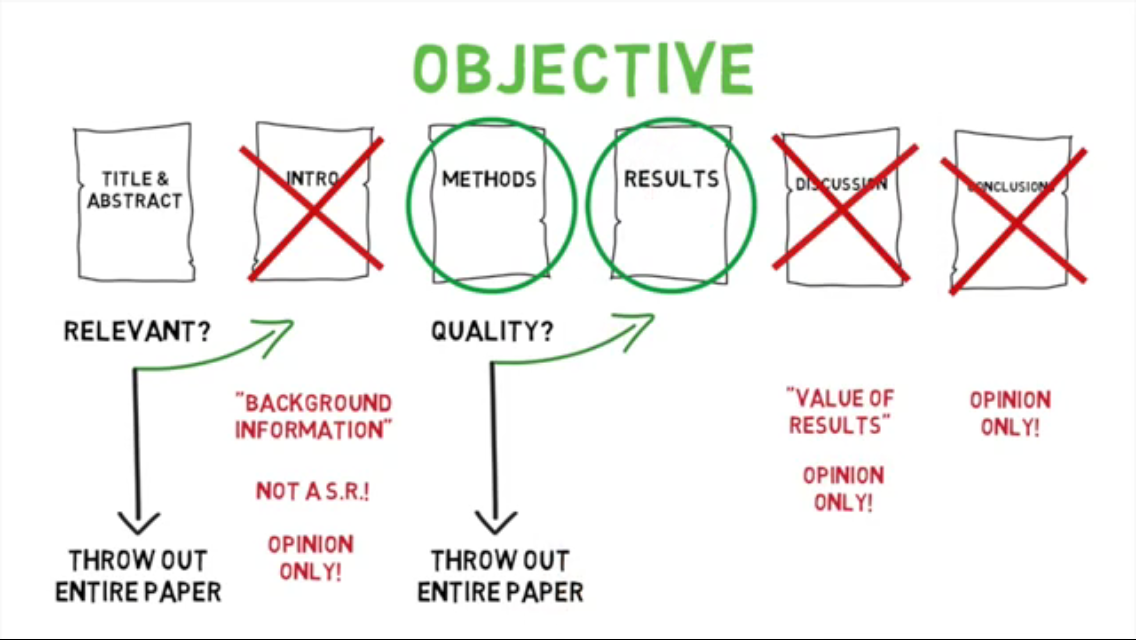 |
| Cartoon by Anthony Crocco |
But I've had this discussion in person too, with assistant professors in our department. And I just don't get it. To me, a paper without the introduction and the discussion is almost literally nonsensical.
The intro, discussion, and conclusion have value because I don't view them as opinion, but as argument. The introduction should set up WHY the problem is interesting to the field, and why the approach chosen is relevant. This isn't just set up. It tells me a number of useful things: whether the person knows what they are doing with regard to the broader intellectual climate they are working in for one, but also, their thoughts on why the problem is important may not be my own. Their thinking, as detailed in the introduction, may modify, interrogate, change my own. And their thoughts about why the work is worth doing will guide 1) how they did it, and 2) what they intended to get out of it (which is important, because that set up will color how they present BOTH the methods and the results).
What is written in a paper is never just a simple narrative of the work done and the results obtained. That is a stylistic conceit. So knowing the set up is essential for critically assessing the "objective" parts (which are not so objective).
But it is the dismissal of the discussion that makes me saddest. The implication that the discussion can be discarded means that what the authors think of their results is irrelevant. There may be fields (particle physics perhaps) where the results are entirely unambiguous. I have yet to encounter a biological problem in which that is the case. Moreover, the non linear hierarchical interaction of biological systems (from molecules to cells to organs to organisms to behavior to ecology to evolution) mean that from an integrated biology perspective, I want to know about potential implications of the resultsfor connected elements of the biological hierarchy of organization. Again, a well crafted discussion is an argument, and a source of ways forward, not the spewing of opinion.
But perhaps what makes me saddest about the sentiment expressed in that cartoon is the solipsistic vision of science it produces. A focus on methods and results discounts the intellectual work, the scholarship done by your peers. It views others' work solely in light of how it might relate to one's own, and assumes that modes of thought about scientific problems are already so fixed, that nothing new will ever be found under the sun. This is not my experience of science.
In my field (evolutionary biology), one of the most important events that ever occurred was the Modern Synthesis. Over the course of ten to fifteen years, a disparate group of biologists came together to generate the modern understanding of evolution by natural selection, rooted in population genetics. The modern synthesis involved no ground breaking discoveries, and happened before we even properly understood the molecular mechanisms of heredity. The modern synthesis was the result of years of discussion and argument, culminating in, not a series of papers detailing new methods and new techniques, but in a series of books detailing a new way of thinking about biology. Crucially, it involved biologists from other fields understanding each other's work, despite being unfamiliar with each other's methods. If Mayr, Simpson, Dobzhansky, Huxley, and Stebbins had only engaged with their colleagues work through the schema of that cartoon, the modern synthesis would have been impossible.
In my field (evolutionary biology), one of the most important events that ever occurred was the Modern Synthesis. Over the course of ten to fifteen years, a disparate group of biologists came together to generate the modern understanding of evolution by natural selection, rooted in population genetics. The modern synthesis involved no ground breaking discoveries, and happened before we even properly understood the molecular mechanisms of heredity. The modern synthesis was the result of years of discussion and argument, culminating in, not a series of papers detailing new methods and new techniques, but in a series of books detailing a new way of thinking about biology. Crucially, it involved biologists from other fields understanding each other's work, despite being unfamiliar with each other's methods. If Mayr, Simpson, Dobzhansky, Huxley, and Stebbins had only engaged with their colleagues work through the schema of that cartoon, the modern synthesis would have been impossible.
Wednesday, 5 August 2015
Growth
I am currently writing a manuscript. It's the second first author manuscript to come from my postdoctoral work (a little under two years in), and hopefully it will be sent out for review in the next couple of weeks. Currently, my PI and I are sending it back and forth, querying the writing, clarifying the main points, realising (for me at least) some pretty large gaps in my knowledge of the litterature. But, at no point since I wrote the first draft have either my PI or I thought anything other than "this is a good manuscript, we just need to make it even better".
This is in many ways the paper I came here to write. It's the paper that shows that I understand how to do biological kinematics, that is how to study the movement of biological structures as organisms use them. As I've mentioned elsewhere, my background (which now seems quite far off) is in ecomorphology as applied to the fossil record. I correlated variation in mammalian bone morphology with known variation in broad categorical behavioral and ecological variables. But these broad classifications don't tell you about function, and so about the behavioral phenotype on which selection is acting. So I took this postdoc in part to learn how to ask those questions.
And here I am, writing a paper that does just that, yet also so much more than I had anticipated. The study we did was an experimental manipulation to see how a nerve lesion affected the movement of the tongue and oro-pharynx in our animal model. The work replicates a relatively frequent iatrogenic injury in premature human infants, and so it is clinically relevant. But the direction we have taken with this paper is so much more than that. We're using the changes we observe to make inference about the neurological control of these oro pharyngeal structures. My head has, for the past few weeks, been full of discussion of central pattern generators, afferent and efferent pathways.
With this paper, I feel like I have grown immensely as a scientist. I have become the integrative biologist I've always wanted to be. I'm not doing it in this paper yet, but I feel ready to connect my paleontological work and knowledge of mammalian evolution with my understanding of experimental organismal physiology.
I have an idea of the direction I want to head in as a paleontologist, as a evolutionary biologist, as a mammalian physiologist. And it's so much more than I thought it would be when I started this project hoping to learn about kinematics.
I'm heading out onto the job market this year. And my research statement will be nothing like the one I wrote three years ago when I was finishing my PhD. I think it will be so much more interesting. And I hope others will too.
This is in many ways the paper I came here to write. It's the paper that shows that I understand how to do biological kinematics, that is how to study the movement of biological structures as organisms use them. As I've mentioned elsewhere, my background (which now seems quite far off) is in ecomorphology as applied to the fossil record. I correlated variation in mammalian bone morphology with known variation in broad categorical behavioral and ecological variables. But these broad classifications don't tell you about function, and so about the behavioral phenotype on which selection is acting. So I took this postdoc in part to learn how to ask those questions.
And here I am, writing a paper that does just that, yet also so much more than I had anticipated. The study we did was an experimental manipulation to see how a nerve lesion affected the movement of the tongue and oro-pharynx in our animal model. The work replicates a relatively frequent iatrogenic injury in premature human infants, and so it is clinically relevant. But the direction we have taken with this paper is so much more than that. We're using the changes we observe to make inference about the neurological control of these oro pharyngeal structures. My head has, for the past few weeks, been full of discussion of central pattern generators, afferent and efferent pathways.
With this paper, I feel like I have grown immensely as a scientist. I have become the integrative biologist I've always wanted to be. I'm not doing it in this paper yet, but I feel ready to connect my paleontological work and knowledge of mammalian evolution with my understanding of experimental organismal physiology.
I have an idea of the direction I want to head in as a paleontologist, as a evolutionary biologist, as a mammalian physiologist. And it's so much more than I thought it would be when I started this project hoping to learn about kinematics.
I'm heading out onto the job market this year. And my research statement will be nothing like the one I wrote three years ago when I was finishing my PhD. I think it will be so much more interesting. And I hope others will too.
Wednesday, 17 June 2015
The value of capable
Today was a tough day in the lab. Supertech and I are flying solo (PI is away), and we are running two weeks of experiments using a rather expensive, and rather delicate, piece of custom built equipment. The experiments are supposed to be straightforward. As today showed, "supposed" is the operative word here.
It should be noted that supertech and I (well, mostly supertech. I just help) are pretty anal about planning experiments. We put a lot of thought into how the experiments are going to run, and we test as much as we can beforehand. The reason for this is that once experiments start, there is no time to think. Baby animals are screaming to be fed, multiple multi hour surgeries need to be done, and we need to make sure that people don't get irradiated by the high powered fluoroscopes (there are two). The simple act of getting through experiments drains brains and nerves.
But even with the best laid plans, things go wrong. Not everything can be anticipated. Which lead to today, when our expensive piece of machinery (basically, a series of precise electronically controlled pumps) stopped working. With four screaming hungry pigs in the room.
As in turned out, a crucial piece of information had been left out when discussing the design of the system (before I or Supertech joined the lab). Why? Who knows. The same reason that, with hindsight, really obvious things are missed from experimental planning. Essentially, the pumps got fouled up by the radio opaque particulates in the liquid we pump. Two weeks of experiments and four animals were at stake.
Supertech and I then went into super capable mode. We troubleshooted the system every way we knew. I called the manufacturer, and confirmed what the issue was. We found a way to clean the pumps, and then started to work on solving the problem that our fluid had particles that were too large. Within an hour we had three possible solutions. Within two hours we had started to put in place all three. By seven pm this evening, Supertech and her husband had built a high volume filtering system that would remove the large particles from our suspension (we'd already by this point checked that this kept the solution radio opaque). Tomorrow experiments will resume, and we will only be one day behind.
As a lab team, supertech and I are capable. We can deal on the fly with most crises. When something goes wrong, within half an hour we have a plan, within a hour we're putting it in place. We brainstorm, prioritize, call people and get things fixed. She's better than I am, but I pull my weight. I don't think we've lost much more than a week on any experimental schedule, and that was due to unforeseen animal death. We have stayed overnight in the lab to care for sickly animals. We've harassed suppliers to get things overnighted. We've become conversant in technical topics we knew nothing about. We get things done.
For the science, this is great. For the animals, this is essential. But for us... I worry. I worry that capability, the ability to creatively solve problems on the fly, and to put in the effort to do it, doesn't always reap the rewards equivalent to its cost in hours and stress. I don't mean to impugn our PI. She treats us exceptionally well, recognizes our efforts, and has rewarded us with substantial autonomy and authority on the running of the lab. I mean rather, that the labor market since Taylor and Ford has been structured so as not to rely on the capable worker. To a manufacturer, the added value of a capable line worker is marginal compared to a merely adequate one. And in science, techs and postdocs (and graduate students) are somewhat like manufacturing labor. Yes, a good postdoc adds value to the lab, but how much value relative to a merely adequate one?
Many of my smart, capable friends in other jobs hide their capability, revealing it only to those they trust not to exploit it. Capable people need to learn to say no, because they get asked to do more than most, and all of the difficult, non rote tasks. And problem solving is tiring work.
I like being capable. I like not being helpless in the face of problems. But I worry that capability is a liability, because it becomes assumed, and because its value to the beneficiaries is less than its cost to those who do the capable work.
It should be noted that supertech and I (well, mostly supertech. I just help) are pretty anal about planning experiments. We put a lot of thought into how the experiments are going to run, and we test as much as we can beforehand. The reason for this is that once experiments start, there is no time to think. Baby animals are screaming to be fed, multiple multi hour surgeries need to be done, and we need to make sure that people don't get irradiated by the high powered fluoroscopes (there are two). The simple act of getting through experiments drains brains and nerves.
But even with the best laid plans, things go wrong. Not everything can be anticipated. Which lead to today, when our expensive piece of machinery (basically, a series of precise electronically controlled pumps) stopped working. With four screaming hungry pigs in the room.
As in turned out, a crucial piece of information had been left out when discussing the design of the system (before I or Supertech joined the lab). Why? Who knows. The same reason that, with hindsight, really obvious things are missed from experimental planning. Essentially, the pumps got fouled up by the radio opaque particulates in the liquid we pump. Two weeks of experiments and four animals were at stake.
Supertech and I then went into super capable mode. We troubleshooted the system every way we knew. I called the manufacturer, and confirmed what the issue was. We found a way to clean the pumps, and then started to work on solving the problem that our fluid had particles that were too large. Within an hour we had three possible solutions. Within two hours we had started to put in place all three. By seven pm this evening, Supertech and her husband had built a high volume filtering system that would remove the large particles from our suspension (we'd already by this point checked that this kept the solution radio opaque). Tomorrow experiments will resume, and we will only be one day behind.
As a lab team, supertech and I are capable. We can deal on the fly with most crises. When something goes wrong, within half an hour we have a plan, within a hour we're putting it in place. We brainstorm, prioritize, call people and get things fixed. She's better than I am, but I pull my weight. I don't think we've lost much more than a week on any experimental schedule, and that was due to unforeseen animal death. We have stayed overnight in the lab to care for sickly animals. We've harassed suppliers to get things overnighted. We've become conversant in technical topics we knew nothing about. We get things done.
For the science, this is great. For the animals, this is essential. But for us... I worry. I worry that capability, the ability to creatively solve problems on the fly, and to put in the effort to do it, doesn't always reap the rewards equivalent to its cost in hours and stress. I don't mean to impugn our PI. She treats us exceptionally well, recognizes our efforts, and has rewarded us with substantial autonomy and authority on the running of the lab. I mean rather, that the labor market since Taylor and Ford has been structured so as not to rely on the capable worker. To a manufacturer, the added value of a capable line worker is marginal compared to a merely adequate one. And in science, techs and postdocs (and graduate students) are somewhat like manufacturing labor. Yes, a good postdoc adds value to the lab, but how much value relative to a merely adequate one?
Many of my smart, capable friends in other jobs hide their capability, revealing it only to those they trust not to exploit it. Capable people need to learn to say no, because they get asked to do more than most, and all of the difficult, non rote tasks. And problem solving is tiring work.
I like being capable. I like not being helpless in the face of problems. But I worry that capability is a liability, because it becomes assumed, and because its value to the beneficiaries is less than its cost to those who do the capable work.
Tuesday, 19 May 2015
Why I'm excited about the opah
Last week, a new paper in Science (Wegner et al. 2015) announced that they had discovered whole body endothermy (that is, the ability to generate metabolic heat to keep the temperature of the internal organs above ambient temperature) in a pelagic bony fish. This fact is intrinsically cool, but as a mammalian paleontologist who is interested in the evolution of mammalian physiology, I was immediately intrigued and excited to know more.
Everyone knows that mammals and birds are "warm blooded", that is that they maintain a stable body temperature that is above that of the environment. Usually, they are described this way to distinguish them from lizards, snakes, crocodiles, amphibians and fish, collectively referred to as "cold blooded". But the details of heat physiology are much more complex than this simplistic dichotomy. At the most fundamental level, there are two different, and related axes of variation along which animals can be placed to describe their body temperature physiology.
One axis separates animals that maintain a constant body temperature (known as homeotherms) from animals that do not (known as poikilotherms, a personal favorite word of mine). The other axis separates endotherms, that is animals that use the heat generated by internal metabolic processes (such as muscle contraction) to warm their internal organs, versus ectotherms, that use environmental sources (most often the sun, but sometimes other sources such as hot springs) to heat themselves.
Now here's what's really fascinating. If you imagine a plot with these two axis, you will find organisms all over it. You will find ectotherms that are excellent homeotherms, and endotherms that are highly poikilothermic (many tropical marsupials fall in this category). What is more, most animals can occupy, depending on the environment they're in and the specifics of their physiology, multiple positions in this space.
Of particular interest to this debate are the many ocean going, highly active predatory fish that have evolved varying degrees of facultative endothermy. These are animals (such as tuna and sharks), that use a specific arrangement of blood vessels called a counter current exchanger to trap the heat generate by muscle activity in their swimming muscles, thus allowing them to keep those muscles at the best temperature for efficient function in cold water. The limitation of this strategy, however, is that eventually the heart cools down, slowing down its pumping rate and starving the muscles of oxygen.
Which is where the opah comes in. It flips the script on what other facultative endotherms do, and places the counter current exchanger in the gills (I urge to go and look at the paper now; the pictures of those gill counter current exchangers are breathtaking). As the gills are in direct contact with water, they are a major site of heat loss. Mammals and birds have similar problem in the respiratory system, and have independently evolved highly vascularised nasal turbinates which also use vascular counter current exchange to trap heat inside the body cavity during exhalation. By placing the counter current exchangers in its gills, the opah (if physicists will forgive me this inaccurate metaphor) traps the cold outside its body (thus brilliantly illustrating Claude Bernard's definition of homeostasis). Furthermore, evidence suggests that the opah may use its pectoral fin muscles purely to generate heat, rather than to aid in locomotion, thus fulfilling the strictest definition of endothermy (that is, the use of metabolic energy purely for the generation of heat). Finally, the opah has developed significant insulation the form of fat, so as to prevent heat loss through the skin. The upshot of all this is that the opah's internal organs, including its heart, remain considerably warmer than the surrounding water.
So it seems pretty clear the opah is probably a homeothermic endotherm, and probably a pretty good one. It is always exciting to see a completely unexpected organism have converged on an evolutionary solution that we thought only another organism had achieved. But what really got me excited was the discussion of why the opah might have evolved this form of life. Namely, facultative endotherms like tuna must eventually leave cold deep waters (which are rich in fish) for sun-warmed surface waters when their hearts cool down. The opah, through its metabolically expensive endothermy, can remain in those waters permanently. Why is this exciting? Because the exploitation of a cold environment is exactly the scenario that has been advanced for the evolution of endothermy in mammals. Namely, it has been suggested that mammalian endothermy allowed triassic mammals to hunt at night, when other, ectothermic amniotes would be sluggish. In the opah, we have validation of the hypothesis that endothermy can evolve so that a thermally constrained niche can be exploited.
Biology training is becoming increasingly narrow, yet also increasingly broad. We study systems in limited model organisms, and then expand the mechanisms across groups without consideration of the ecological, and evolutionary specificities that have made these organisms what they are. But if our evolutionary scenarios make sense, then we should expect them to be repeated: the biological equivalent of the old maxim that the same causes produce the same effects. In the opah, we find, unexpectedly, confirmation of our hypotheses on the ecological situations that underpin the evolution of endothermy. In the study of the opah's evolution, we may gain insight into the variety of thermoregulatory solutions that accompany such trends. Comparative physiology, broadly studied and understood, is full of unsuspected explanatory power.
Everyone knows that mammals and birds are "warm blooded", that is that they maintain a stable body temperature that is above that of the environment. Usually, they are described this way to distinguish them from lizards, snakes, crocodiles, amphibians and fish, collectively referred to as "cold blooded". But the details of heat physiology are much more complex than this simplistic dichotomy. At the most fundamental level, there are two different, and related axes of variation along which animals can be placed to describe their body temperature physiology.
One axis separates animals that maintain a constant body temperature (known as homeotherms) from animals that do not (known as poikilotherms, a personal favorite word of mine). The other axis separates endotherms, that is animals that use the heat generated by internal metabolic processes (such as muscle contraction) to warm their internal organs, versus ectotherms, that use environmental sources (most often the sun, but sometimes other sources such as hot springs) to heat themselves.
Now here's what's really fascinating. If you imagine a plot with these two axis, you will find organisms all over it. You will find ectotherms that are excellent homeotherms, and endotherms that are highly poikilothermic (many tropical marsupials fall in this category). What is more, most animals can occupy, depending on the environment they're in and the specifics of their physiology, multiple positions in this space.
Of particular interest to this debate are the many ocean going, highly active predatory fish that have evolved varying degrees of facultative endothermy. These are animals (such as tuna and sharks), that use a specific arrangement of blood vessels called a counter current exchanger to trap the heat generate by muscle activity in their swimming muscles, thus allowing them to keep those muscles at the best temperature for efficient function in cold water. The limitation of this strategy, however, is that eventually the heart cools down, slowing down its pumping rate and starving the muscles of oxygen.
Which is where the opah comes in. It flips the script on what other facultative endotherms do, and places the counter current exchanger in the gills (I urge to go and look at the paper now; the pictures of those gill counter current exchangers are breathtaking). As the gills are in direct contact with water, they are a major site of heat loss. Mammals and birds have similar problem in the respiratory system, and have independently evolved highly vascularised nasal turbinates which also use vascular counter current exchange to trap heat inside the body cavity during exhalation. By placing the counter current exchangers in its gills, the opah (if physicists will forgive me this inaccurate metaphor) traps the cold outside its body (thus brilliantly illustrating Claude Bernard's definition of homeostasis). Furthermore, evidence suggests that the opah may use its pectoral fin muscles purely to generate heat, rather than to aid in locomotion, thus fulfilling the strictest definition of endothermy (that is, the use of metabolic energy purely for the generation of heat). Finally, the opah has developed significant insulation the form of fat, so as to prevent heat loss through the skin. The upshot of all this is that the opah's internal organs, including its heart, remain considerably warmer than the surrounding water.
So it seems pretty clear the opah is probably a homeothermic endotherm, and probably a pretty good one. It is always exciting to see a completely unexpected organism have converged on an evolutionary solution that we thought only another organism had achieved. But what really got me excited was the discussion of why the opah might have evolved this form of life. Namely, facultative endotherms like tuna must eventually leave cold deep waters (which are rich in fish) for sun-warmed surface waters when their hearts cool down. The opah, through its metabolically expensive endothermy, can remain in those waters permanently. Why is this exciting? Because the exploitation of a cold environment is exactly the scenario that has been advanced for the evolution of endothermy in mammals. Namely, it has been suggested that mammalian endothermy allowed triassic mammals to hunt at night, when other, ectothermic amniotes would be sluggish. In the opah, we have validation of the hypothesis that endothermy can evolve so that a thermally constrained niche can be exploited.
Biology training is becoming increasingly narrow, yet also increasingly broad. We study systems in limited model organisms, and then expand the mechanisms across groups without consideration of the ecological, and evolutionary specificities that have made these organisms what they are. But if our evolutionary scenarios make sense, then we should expect them to be repeated: the biological equivalent of the old maxim that the same causes produce the same effects. In the opah, we find, unexpectedly, confirmation of our hypotheses on the ecological situations that underpin the evolution of endothermy. In the study of the opah's evolution, we may gain insight into the variety of thermoregulatory solutions that accompany such trends. Comparative physiology, broadly studied and understood, is full of unsuspected explanatory power.
Monday, 30 March 2015
Fallingwater: on excellence and mediocrity
Coming back from a weekend with friends two weeks ago I had the opportunity to fulfill a long time wish: I managed to visit Fallingwater. I've been in love with Frank Lloyd Wright's masterpiece of integrated design since I first found out about it. Finally, I was about to see it in person. It provoked the same response in me that the Taj Mahal did: no matter how many photographs of it I'd seen, the experience of being in its presence was overwhelming. Much like the Taj, Fallingwater is exquisite craft expressing conceptual genius at almost every level of analysis.

As we left Fallingwater, we drove through miles of countryside scattered with new builds. Within minutes of one of the most inspiring houses ever built, we were back in standard, prefabricated MacMansions that stuck out on hills, with terraces and balconies jutting out at odd angles. It was disappointing. So little of Lloyd Wright's careful thought about the integration of architecture and landscape, about the use of light and space, heck even about using cantilevered concrete rather than wooden post and plasterboard to deal with steep inclines, has made it into the bulk of modern architecture.
Going further, if we look at the glass-and-steel monoliths that increasingly dot cities and university campuses, which of them really display anything like the intricate thought of Fallingwater, or the Guggenheim in New York? I remember in London, before I left, my first encounter with the base of the Shard. I was wondering how the architect has sought to integrate this glass and steel behemoth with the ramshackle brick buildings around it? The answer: not at all. The glass and steel cladding simply descended into a canopied atrium, as if the starship of a spectacularly aesthetically unsophisticated alien species had crash landed on south London.
When confronted the reality of how little brilliance like Fallingwater affects day to day construction, how little careful ideas about the spaces we live in seems to have affected the practice of how and what we build, one is tempted to get depressed. And I would hazard that similar things happen in science. How often do we get frustrated that ideas that were soundly and brilliantly rejected years ago continue to have a zombie life in the literature? How often do we complain that the nuance and subtlety in the source materials of innovative ideas is lost in the work of those who pursue those ideas? My recent experience at the clinical meeting highlighted how little people were thinking about new ideas and new directions, and how much time was being devoted to flogging dead horses. And in my old field of paleontology, many of the scientist doing the most interesting and subtle work get ignored in favor of self promoters doing the same old thing, with newer analyses tacked on for flashiness (much like modern house building in fact).
If in architecture, as in science, brilliant, thoughtful ideas and approaches get so diluted in the mass, how do we, as individuals, keep doing good work? The best I can come up with is to think critically about the bad stuff, regularly engage with the good, and shoot for an architect designed house.
I am not Frank Lloyd Wright of experimental biology, evolutionary biology or paleontology. But I have had the good fortune to work with people who think about science like he thought about buildings: carefully, yet radically, questioning all the tools we use, how we use them, and our approaches. And ultimately, the reward of working like that is to assemble something complete, integrated, beautiful, inspiring, and good.
Tuesday, 24 February 2015
Telling stories about the real world
Science is very good, on the whole, at what it does: establishing predictable facts about the natural world. It's probably fair to say that modern science, in so far as there is such a thing, is better at this than pretty much any other system that humans have ever devised. As scientists, we are often tempted to take other areas of human knowledge gathering to task for not behaving enough like science in their attitude to establishing facts about the world. We berate and bemoan the lack or misuse of evidence. We pour (sometimes deserved) scorn on the apparent flimsiness of other enterprises. In two very interesting posts, drugmonkey discusses why journalism and law can be so unappealing to the scientifically trained. I don't disagree with everything he says, and I think that certainly parts of both could stand to be held to more scientific standards of evidence.
And yet, I am always a little cautious about yelling "be more scientific" at people. Scientists as a whole have a bad a case of epistemological "PC gaming master race" syndrome (if I ever make a nerdier analogy, shoot me). We are convinced of the innate superiority of our means of knowing what we know. This view is hubris. On the one hand, as has been shown time and again by historians, philosophers and sociologists of science, it is remarkably difficult to pin down, at any time in history, a single definition of what constitutes the scientific method. What's more, efforts to do so have often lead to awkward situations, such as Karl Popper's continuous flip flopping over whether evolution by natural selection could be considered scientific. (One of the many reasons I dislike Karl Popper). On the other, there are entire areas of enquiry in which applying the many commonly accepted facets of the "scientific method" (hypothesis testing by experiment, replication) is difficult, impossible, or wrong headed. And no, I'm not talking about your position on omnipotent beings awkwardly obsessed with judging humans. I'm talking about the two things that are (not coincidentally) crucial in both journalism and courts of law: the reconstruction of historical events and the determination of people's internal states.
Wait, I here you cry, are you claiming history is not a science? Well, no. What I am claiming (and the philosopher Anton Schopenhauer got there first) is that one cannot apply an experimental framework to individual point event in the past, and furthermore that the range of applicability of hypothetico-deductive methods is much more limited. And when attempting to ascertain the truth behind a single event, in the past, never to be repeated (such as a current event, or a crime), what are we left with? Testimony, correlation, hearsay. Also known as a case. Also known as a story. Neither Baconian empiricism, nor hypothetico-deductivism, nor Popperian faslificationism, will help us here. At best, they will allow us to evaluate some (though by no means all) the evidence. In essence, the repeatable experiment is a tool for erasing the singular nature of point events (and it is much more difficult to do then often presented).
This exact problem is one that plagues my original discipline of paleontology. Paleontology is, in many ways, history writ large. Except it is not writ, more sort of left lying around. Many of the events we would like to understand are unobservable, their consequence inferred from disparate sources of evidence observed in the here and now. And the paleontological literature is rife with people grappling with the problem of just how scientific this endeavor is. And they run the gamut, from people twisting Popper's theory into an unrecognizable pretzel to accommodate paleontological historicity, to people consigning vast tracts of what is normally considered part of paleo to the dustbin of unscientific speculation. Neither approach is satisfying, and both end up running into absurdity and intellectual sterility. Paleontology is largely historical, as such the best we can do is marshal evidence for competing narratives, and go with the most plausible. Some of that evidence will fit with more prescriptive definitions of the scientific method, most (and I count most cases of fossil discovery in this category) will not.
As for the reconstruction of the internal states of a person at a given time and place, science isn't even close to figuring that one out. Yet we, as humans, are always in the business of trying to figure out what's going on in another person's head. And, in the West at least, it is literature that has grappled most directly with this problem, through what one could describe as thought experiments, but that we usually call novels. As the philosopher Mary Midgley once wrote:
Abandoning the notion that a one-size-fits-all epistemological framework derived from the physical sciences can be applied across all areas of possible human knowledge is not the same as saying "anything goes". Rather, it is a requirement that we be more rigorous, more critical, more demanding of the evidence and narratives presented to us given the constraints of what it is we are trying to understand and know. Indeed, the uncritical acceptance of a superficially science-y framework can be as dangerous for critical thought as any narrative-based understanding of the world (this is what Richard Feynman described as cargo cult science). We should have more that one tool in our epistemological kit. The world of things that are knowable is complex enough to need them.
PS: While researching this post, I found this delightful Schopenhauer quote we can probably all agree on:
"Newspapers are the second hand of history. This hand, however, is usually not only of inferior metal to the other hands, it also seldom works properly."
And yet, I am always a little cautious about yelling "be more scientific" at people. Scientists as a whole have a bad a case of epistemological "PC gaming master race" syndrome (if I ever make a nerdier analogy, shoot me). We are convinced of the innate superiority of our means of knowing what we know. This view is hubris. On the one hand, as has been shown time and again by historians, philosophers and sociologists of science, it is remarkably difficult to pin down, at any time in history, a single definition of what constitutes the scientific method. What's more, efforts to do so have often lead to awkward situations, such as Karl Popper's continuous flip flopping over whether evolution by natural selection could be considered scientific. (One of the many reasons I dislike Karl Popper). On the other, there are entire areas of enquiry in which applying the many commonly accepted facets of the "scientific method" (hypothesis testing by experiment, replication) is difficult, impossible, or wrong headed. And no, I'm not talking about your position on omnipotent beings awkwardly obsessed with judging humans. I'm talking about the two things that are (not coincidentally) crucial in both journalism and courts of law: the reconstruction of historical events and the determination of people's internal states.
Wait, I here you cry, are you claiming history is not a science? Well, no. What I am claiming (and the philosopher Anton Schopenhauer got there first) is that one cannot apply an experimental framework to individual point event in the past, and furthermore that the range of applicability of hypothetico-deductive methods is much more limited. And when attempting to ascertain the truth behind a single event, in the past, never to be repeated (such as a current event, or a crime), what are we left with? Testimony, correlation, hearsay. Also known as a case. Also known as a story. Neither Baconian empiricism, nor hypothetico-deductivism, nor Popperian faslificationism, will help us here. At best, they will allow us to evaluate some (though by no means all) the evidence. In essence, the repeatable experiment is a tool for erasing the singular nature of point events (and it is much more difficult to do then often presented).
This exact problem is one that plagues my original discipline of paleontology. Paleontology is, in many ways, history writ large. Except it is not writ, more sort of left lying around. Many of the events we would like to understand are unobservable, their consequence inferred from disparate sources of evidence observed in the here and now. And the paleontological literature is rife with people grappling with the problem of just how scientific this endeavor is. And they run the gamut, from people twisting Popper's theory into an unrecognizable pretzel to accommodate paleontological historicity, to people consigning vast tracts of what is normally considered part of paleo to the dustbin of unscientific speculation. Neither approach is satisfying, and both end up running into absurdity and intellectual sterility. Paleontology is largely historical, as such the best we can do is marshal evidence for competing narratives, and go with the most plausible. Some of that evidence will fit with more prescriptive definitions of the scientific method, most (and I count most cases of fossil discovery in this category) will not.
As for the reconstruction of the internal states of a person at a given time and place, science isn't even close to figuring that one out. Yet we, as humans, are always in the business of trying to figure out what's going on in another person's head. And, in the West at least, it is literature that has grappled most directly with this problem, through what one could describe as thought experiments, but that we usually call novels. As the philosopher Mary Midgley once wrote:
"That is why literature is such an important part of our lives - why the notion that it is less important than science is so mistaken, Shakespeare and Tolstoy help us to understand the self-destructive psychology of despotism. Flaubert and Racine illuminate the self-destructive side of love. What we need to grasp in such cases is not the simple fact that people are acting against their interests. We know that; it stands out a mile. We need to understand, beyond this, what kind of gratification they are getting in acting this way."
Ironically, two of the authors who most thoroughly embraces this task of literature, Emile Zola and Marcel Proust, both believed that their novels were eminently empirical and yes, scientific.Abandoning the notion that a one-size-fits-all epistemological framework derived from the physical sciences can be applied across all areas of possible human knowledge is not the same as saying "anything goes". Rather, it is a requirement that we be more rigorous, more critical, more demanding of the evidence and narratives presented to us given the constraints of what it is we are trying to understand and know. Indeed, the uncritical acceptance of a superficially science-y framework can be as dangerous for critical thought as any narrative-based understanding of the world (this is what Richard Feynman described as cargo cult science). We should have more that one tool in our epistemological kit. The world of things that are knowable is complex enough to need them.
PS: While researching this post, I found this delightful Schopenhauer quote we can probably all agree on:
"Newspapers are the second hand of history. This hand, however, is usually not only of inferior metal to the other hands, it also seldom works properly."
Tuesday, 10 February 2015
We need to talk about the dissertation
It's been over two years since I picked up the 8 bound copies of my dissertation from the library of Johns Hopkins University. The box weighed a ton. The printing had cost me a fair amount of money I no longer had by that point. I confess that when, upon asking her if she wanted a bound copy, my mother said "yes", I was more than a little annoyed. That was another 400 sheets of acid free paper, another 40 dollar binding fee. I dutifully handed my advisor and my department a copy, posted two more to my US based committee members, and boarded the plane back to the UK with three hard copies, because they took up too much of my limited baggage allowance to be worth putting in the hold. Of those copies, I handed one to my committee member who was in Glasgow, one came back with me to the US when I started my postdoc. The third is on the table in my mother's office, more or less exactly where she put it two years ago, slowly getting covered by bills and newspaper clippings.
If you've read this post, you'll probably find the sentence above an apt metaphor for the fate of dissertations such as mine. My program still required dissertations to be written in the monographic format, and despite vague encouragement to publish during my PhD, my advisor never pushed me to realise that my focus on my dissertation as a monolithic project was a liability. Thus, none of that 400 page tome was published by the time I finished up my program. And to this date, all of it that is published is this (unless you count four conference abstracts, which no one does). Other than that, there's a revise and resubmit that's been in limbo for almost a year at this point. And when that gets published, that'll be it, I think.
Given the above, you'd probably think I'm kind of sour on monographic dissertations. And I won't deny that the CVs of graduate students from paper focused programs made me jealous when graduating. Certainly my affection for the object itself is limited. But I am still proud of what's within those pages. That project is solid, cohesive science I would (and have) stand up and take ownership of. It's grounded in a deep understanding of the issues that drove it, both methodological and theoretical. It leveraged under used ressources (museum collections). Moreoever, it is the brainchild of my own intellectual development. Thanks to my masters, I was already well versed in the techniques I applied in my PhD, and I knew the kinds of questions I wanted to ask. I chose to work with my advisor because he too was interested in those questions, and because he has access to the resources (fossils) i needed to do my project. So the intellectual process that lead to my dissertation I am proud of, and happy with. Like others, I defend the holistic, root and branch approach to science that a good monographic dissertation requires. But only up to a point. And the point at which I stop defending the monographic thesis is the point at which it hobbles the already dim career prospects of graduate students. More fundamentally, the point at which it perpetuates the lie that your research is valued irrespective of your productivity, which is publication. If graduate school is training for academia, then it must reflect the reality of academia. And that is both that your work must be thorough, rigorous, and yours, and that it must be published.
Instead of focusing on sterile arguments about whether or not three papers bound together counts as a dissertation, we need to work on developing a system of awarding graduate degrees that both encourages and develops thorough, original thinking and research in science, and which encourages regular, high quality publication of said research. Rather than end this post on my half baked ideas, I'd like to hear your thoughts on the topic.
If you've read this post, you'll probably find the sentence above an apt metaphor for the fate of dissertations such as mine. My program still required dissertations to be written in the monographic format, and despite vague encouragement to publish during my PhD, my advisor never pushed me to realise that my focus on my dissertation as a monolithic project was a liability. Thus, none of that 400 page tome was published by the time I finished up my program. And to this date, all of it that is published is this (unless you count four conference abstracts, which no one does). Other than that, there's a revise and resubmit that's been in limbo for almost a year at this point. And when that gets published, that'll be it, I think.
Given the above, you'd probably think I'm kind of sour on monographic dissertations. And I won't deny that the CVs of graduate students from paper focused programs made me jealous when graduating. Certainly my affection for the object itself is limited. But I am still proud of what's within those pages. That project is solid, cohesive science I would (and have) stand up and take ownership of. It's grounded in a deep understanding of the issues that drove it, both methodological and theoretical. It leveraged under used ressources (museum collections). Moreoever, it is the brainchild of my own intellectual development. Thanks to my masters, I was already well versed in the techniques I applied in my PhD, and I knew the kinds of questions I wanted to ask. I chose to work with my advisor because he too was interested in those questions, and because he has access to the resources (fossils) i needed to do my project. So the intellectual process that lead to my dissertation I am proud of, and happy with. Like others, I defend the holistic, root and branch approach to science that a good monographic dissertation requires. But only up to a point. And the point at which I stop defending the monographic thesis is the point at which it hobbles the already dim career prospects of graduate students. More fundamentally, the point at which it perpetuates the lie that your research is valued irrespective of your productivity, which is publication. If graduate school is training for academia, then it must reflect the reality of academia. And that is both that your work must be thorough, rigorous, and yours, and that it must be published.
Instead of focusing on sterile arguments about whether or not three papers bound together counts as a dissertation, we need to work on developing a system of awarding graduate degrees that both encourages and develops thorough, original thinking and research in science, and which encourages regular, high quality publication of said research. Rather than end this post on my half baked ideas, I'd like to hear your thoughts on the topic.
Wednesday, 4 February 2015
Bad DIY is not carpentry: on coding in academia
I have a friend who's hobby is woodworking. Half of the basement of his and his wife's house outside Philadelphia is dedicated to his hobby. The large dining room table around which the family gathers was made by him from the cured wood of an old oak tree he salvaged after a storm. The table is beautiful, inlaid with rosewood, with intricate foldaway leaves. It is precise, the result of years of craft and practice in the service of a single result: to make a beautiful, functional table. Curiously, until he retired, his career was physics. He's never done woodwork for money, only for pleasure. But his work is exquisite.
Conversely, I can barely saw straight. I took shop classes after school, where I learnt the rudiments of planing, sawing, and hammering. I made a box from off cuts of cheap wood, and a toy castle, held together with glue and impatience. I would not use the terms woodwork or carpentry to describe what I do, even though in a pinch, I could probably slap together a vaguely functional table. In fact, I once did. It fell apart after a year and still is the source of much hilarity for my more practically inclined friends.
There is, I think, a distinction in the mindset of woodworking and DIY. Woodworking, though it may have the goal of producing a useful, functional, or beautiful object, is also concerned with the process, materials and skills intrinsic to the craft. A woodworker makes things to become better at woodworking. Conversely, DIY is more utilitarian. The purpose is to produce a functional result, and improvements in skill are valued only in so far as they help achieve the final functional goal.
The point of the above: I think that much of the code and software that is used in modern science fits the definition of DIY, not woodwork.
In our lab, we collect electromyographic data (electrical signals from actively contracting muscles). Because of various properties of the muscles we record from, and because of various properties of the animals we work with, our EMG data require idiosyncratic post-processing before interpretation. To do this post processing, we use a piece of software that was written by a collaborator of my PI probably over a decade ago. Or it is perhaps more appropriate to say, we endure this piece of software. It is unstable, the code is lost, and in fact it is probably written in a legacy language. It was written by an amateur coder whose sole concern was to get it to do the post processing we require. The formatting requirements are fickle, the software is only partially compatible with modern operating systems, and it randomly stops working for reasons we cannot understand. And yet, much like an inexpertly fitted IKEA kitchen, it does the job well enough that we cannot justify the expense of developing something better.
Similarly, my dissertation has about ten pages of Matlab code in it. The code was pretty much when I learnt to write basic manipulations. It is a nightmare of nested for- loops because I never figured out how to do logical matrix indexing, and for- loops did the job. The code does the job, is reasonably well commented, and has meaningful variable names (probably the only good coding practice I have). But it is quasi useless for any project other than my dissertation. And an actual coder would probably rewrite from scratch.
There's a lot of push for scientists to learn to code. And certainly, the ability to do our job these days requires at least the ability to formulate how we would like our data manipulated and to competently explain what the software we use does. I am radically opposed to black box approaches to data analysis software and overly customised solutions. They are anathema to good quantitative analysis that is sensitive to the specific structure of data and to the proper formulation of hypothesis tests. And yet in encouraging a DIY mentality, we encourage the proliferation of cludgy, inelegant, and unreliable software.
Yet those scientists who dedicate themselves to actual code carpentry often feel denigrated as "methods people". We are all grateful for their software (especially when it saves us the effort of writing a miserable few lines of code) yet do we remember to cite them? Do we defend their contributions to the field? I'm part of a macro-ecology journal club that includes a good number of methods people who take pride in writing efficient, elegant, usable code in the R- environment, and these issues come up often.
In an ideal world, we'd make more use of professional software developers. Yet on the other hand, our questions are sufficiently esoteric that I wonder how useful that would be in practice. But I do think we need to be careful of over celebrating a DIY coding ethos, and maybe work to nurture, celebrate, and collaborate with the genuine software carpenters in science more.
There is, I think, a distinction in the mindset of woodworking and DIY. Woodworking, though it may have the goal of producing a useful, functional, or beautiful object, is also concerned with the process, materials and skills intrinsic to the craft. A woodworker makes things to become better at woodworking. Conversely, DIY is more utilitarian. The purpose is to produce a functional result, and improvements in skill are valued only in so far as they help achieve the final functional goal.
The point of the above: I think that much of the code and software that is used in modern science fits the definition of DIY, not woodwork.
In our lab, we collect electromyographic data (electrical signals from actively contracting muscles). Because of various properties of the muscles we record from, and because of various properties of the animals we work with, our EMG data require idiosyncratic post-processing before interpretation. To do this post processing, we use a piece of software that was written by a collaborator of my PI probably over a decade ago. Or it is perhaps more appropriate to say, we endure this piece of software. It is unstable, the code is lost, and in fact it is probably written in a legacy language. It was written by an amateur coder whose sole concern was to get it to do the post processing we require. The formatting requirements are fickle, the software is only partially compatible with modern operating systems, and it randomly stops working for reasons we cannot understand. And yet, much like an inexpertly fitted IKEA kitchen, it does the job well enough that we cannot justify the expense of developing something better.
Similarly, my dissertation has about ten pages of Matlab code in it. The code was pretty much when I learnt to write basic manipulations. It is a nightmare of nested for- loops because I never figured out how to do logical matrix indexing, and for- loops did the job. The code does the job, is reasonably well commented, and has meaningful variable names (probably the only good coding practice I have). But it is quasi useless for any project other than my dissertation. And an actual coder would probably rewrite from scratch.
There's a lot of push for scientists to learn to code. And certainly, the ability to do our job these days requires at least the ability to formulate how we would like our data manipulated and to competently explain what the software we use does. I am radically opposed to black box approaches to data analysis software and overly customised solutions. They are anathema to good quantitative analysis that is sensitive to the specific structure of data and to the proper formulation of hypothesis tests. And yet in encouraging a DIY mentality, we encourage the proliferation of cludgy, inelegant, and unreliable software.
Yet those scientists who dedicate themselves to actual code carpentry often feel denigrated as "methods people". We are all grateful for their software (especially when it saves us the effort of writing a miserable few lines of code) yet do we remember to cite them? Do we defend their contributions to the field? I'm part of a macro-ecology journal club that includes a good number of methods people who take pride in writing efficient, elegant, usable code in the R- environment, and these issues come up often.
In an ideal world, we'd make more use of professional software developers. Yet on the other hand, our questions are sufficiently esoteric that I wonder how useful that would be in practice. But I do think we need to be careful of over celebrating a DIY coding ethos, and maybe work to nurture, celebrate, and collaborate with the genuine software carpenters in science more.
Friday, 2 January 2015
A good start
The holiday season is finally coming to a close, and as always, I have not done as much work as I hoped I would. I long ago accepted that work does not get done over the Christmas break. Now that Christmas invariably involves travelling across an ocean to engage in back to back coffee, lunch, drinks, and dinner with all my friends and family back home, this is doubly true.
I have no regrets about this. I have not been home in over a year, and so for the ten days I was away, my friends and family (and my home town, that I miss deeply) had my undivided attention. I got to see everyone I could. I spent time with my siblings, my mother, my two nephews, and my niece. I saw my oldest friend, whom I've known since I was six. It was important work.
That being said, I had set myself one objective. About two years ago, a friend and colleague of mine and I had discussed a collaboration. It was a side project, but an interesting one, and potentially a new avenue in which to use the methods I focused on in my PhD. It isn't too much work on my part, and the potential returns are large. But life got in the way, and the project has stalled since those discussions. That friend and I will be meeting at the SICB meetings in West Palm Beach later this month, and we had more or less decided that, if we had made no progress by then, the project would be shelved.
It is one of those make or break moments, when you decide how important something is. Well, it appears this was important to me, because this morning I had the workflow breakthrough I was looking for: I've figured out the key data processing steps we need to make this project work. I'm excited again. And I'm taking this as a good sign for 2015: that on the 2nd of January, despite being ill, I got up, went to the local coffee shop (I'm still not home) and worked for a solid three hours until the things I wanted to achieve got done. I still enjoy this, I still want to do this, and there are parts of it I'm actually pretty good at.
So happy new year everybody. May 2015 be filled with little moments like this one.
I have no regrets about this. I have not been home in over a year, and so for the ten days I was away, my friends and family (and my home town, that I miss deeply) had my undivided attention. I got to see everyone I could. I spent time with my siblings, my mother, my two nephews, and my niece. I saw my oldest friend, whom I've known since I was six. It was important work.
That being said, I had set myself one objective. About two years ago, a friend and colleague of mine and I had discussed a collaboration. It was a side project, but an interesting one, and potentially a new avenue in which to use the methods I focused on in my PhD. It isn't too much work on my part, and the potential returns are large. But life got in the way, and the project has stalled since those discussions. That friend and I will be meeting at the SICB meetings in West Palm Beach later this month, and we had more or less decided that, if we had made no progress by then, the project would be shelved.
It is one of those make or break moments, when you decide how important something is. Well, it appears this was important to me, because this morning I had the workflow breakthrough I was looking for: I've figured out the key data processing steps we need to make this project work. I'm excited again. And I'm taking this as a good sign for 2015: that on the 2nd of January, despite being ill, I got up, went to the local coffee shop (I'm still not home) and worked for a solid three hours until the things I wanted to achieve got done. I still enjoy this, I still want to do this, and there are parts of it I'm actually pretty good at.
So happy new year everybody. May 2015 be filled with little moments like this one.
Subscribe to:
Posts (Atom)